
TL;DR
- On the yuu Redeem screen in my account, 4,696 points price to HK$23. A single KFC meal asks for 4,000 points. That matches the common 200 points = HK$1 cash-voucher rate.
- At the published base earn of 1 point per HK$1, that is about a 0.5% rebate before card multipliers or promos [1].
- The Terms and Privacy Policy are clearer than the jingle: points expire, missed scans have tight backfill rules, cancel = forfeit, and membership builds a single profile across DFI brands and Partners.
- Coalition loyalty may still be worth it if most of your spend already sits inside the network and you capture weekly deals or card multipliers. At base rate alone, effort and data often outweigh the cash value.
Related: Why brands need to own customer data · Retail vs banking innovation
Who this is for
Anyone in Hong Kong who opens a loyalty app at the till and wonders whether the ritual is paying for itself. Also useful if you design or buy loyalty: the consumer math and the contract language are the same ledger, read from opposite sides.
The Redeem screen that started this
I opened yuu's Redeem tab and stopped at the header:
| App line | What it prices |
|---|---|
| 4,696 yuu points | Shown as $23 |
| Implied rate | ~204 points per HK$1 (near the common 200:1 cash rate) |
| KFC meal | 4,000 points (~HK$20 at that rate) |
| High-protein 7-Eleven promos | 1,000 points plus cash co-pay on some SKUs |
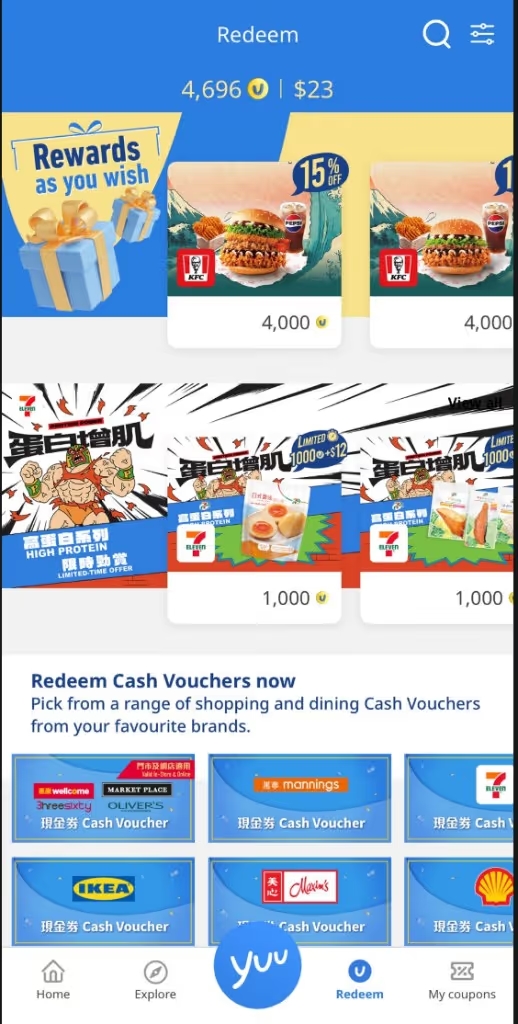 Screenshot: yuu Rewards Club app, Redeem tab; personal account (2026)
Cash vouchers in the same screen span Wellcome / Market Place / 3hreesixty / Oliver's, Mannings, 7-Eleven, IKEA, Maxim's, and Shell. That partner list is the point. One ID sits across grocery, pharmacy, convenience, home, dining, and fuel.
At base earn, funding a 4,000-point meal means about HK$4,000 of eligible partner spend before multipliers [1]. Hang Seng enJoy can raise that to 2×–4× at designated partners, which improves the math if you already carry the card [2]. Without that stack, you are mostly buying a small rebate with a large ritual.
Three stacks you are trading
Diagram: three stacks in the loyalty trade; Petralian (2026)
Bond's 2025 loyalty research found Americans hold about 17.4 memberships on average, with roughly half active, and only about one-third agreeing programs give "good value for money" [3]. Hong Kong shoppers live the same saturation with a denser retail map.
McKinsey has argued for years that many loyalty programs do not improve growth and can compress margins unless the data and behaviour change pay for the points liability [4]. Read that from the consumer side: if the operator's return depends on the profile, a 0.5% face rebate is not a pricing error. It is the menu.
How the rebate really works
| Mode | Rough economics | When it matters |
|---|---|---|
| Base points | 1 pt / HK$1, redeem ~200 pts = HK$1 → ~0.5% [1][2] | Default if you only scan |
| enJoy multipliers | Up to 3× retail / 4× dining at designated partners [2] | Card already in wallet |
| Weekly partner deals | Basket discounts that do not need a huge balance | Dense Wellcome / Mannings shoppers |
| Promo redemptions | Occasional better-than-cash point pricing | Opportunistic redeemers |
Hong Kong's other big coalitions show a similar pattern: base rates stay thin; the card overlay or promo calendar does the real work. Local comparison pieces often put MoneyBack and The Club in the same "base is small, card is the lever" frame [5].
Points are not cash. The Terms say they cannot be exchanged for cash or purchased, and rewards cannot be returned once redeemed [1]. The App is also the gate: in-store registrations that never link to the App cannot redeem until the App is downloaded [1].
The effort tax (and the fine print on missed scans)
The visible tax is the QR. Open app. Brightness up. Wait for the code. Hold it for the scanner. Do it again at Mannings. Again at 7-Eleven. Again at Shell.
The contract tax is quieter:
- Retrospective claims are capped. If you forget the QR at a physical outlet, you may email a receipt within 14 days. You get two retrospective claims per 12 months. Online purchases with a forgotten ID: no retrospective points. Unlinked enJoy + forgotten ID: Additional / Bonus points may be lost. Eligibility is final and binding for yuu and Partners [1].
- Excluded items exist and can change. Base points only apply to non-excluded products; excluded items are "determined by us from time to time" [1].
- Credits can lag up to about a week; refunds claw points back [1].
- Expiry and dormancy. Points expire 3 years after earning. No earn or use for 2 consecutive years → account can close and unspent points are forfeited [1].
- Cancel = wipe. You may cancel anytime. On cancel, the account terminates immediately and all accumulated Points and uncollected Rewards are forfeited [1].
- They can change the programme. Partners, outlets, excluded items, base points, rewards catalogue: amendable. Major changes: notice by email or App/Website. Keep using the account after notice = you agree. Disagree = cancel (and forfeit) [1].
- Liability is thin. Disclaimers are broad. If a court limits those clauses, liability may be capped at providing points or replacing a disputed Reward, at their discretion [1].
So the "forgot to scan" story is not "points forever lost with zero recourse." It is "two lifelines a year, paperwork, physical stores only, subject to refusal." That is still an effort product.
What the privacy policy actually authorises
yuu is operated by DFI Development (HK) Limited, part of DFI Retail Group. Joining Membership, using the Site/App, or the e-comm service means the Privacy Policy is deemed agreed. Disagree → do not join, or cancel and stop using the services [6].
What they collect
For members, that can include identity and contact details, transaction history when you earn points (product/service, date, location, first six digits of card and billing info in e-comm contexts), shopping habits and preferences, interests and lifestyle information, and tracking data from cookies, pixels, and similar tools [6].
What they build with it
Purposes include operating the programme and:
- creating a single profile, combining information held by DFI, DFI Retail Group members, or Partners
- analytics for Marketing Materials on Site, App, DFI sites, and third-party social platforms
- personalised offers and effectiveness measurement
- helping Partners and DFI members improve products, marketing, and strategy [6]
That is the coalition thesis in one sentence: one profile across the partner map.
Who sees it
Sharing covers DFI Retail Group members, Partners (for points processing, support, personalisation, analytics of common customers), service providers (IT, AdTech, analytics, call centres, marketing agencies), professional advisors and deal counterparties, and authorities when required [6]. Membership also includes agreement to cross-border transfer as described in the policy [6].
Direct marketing to you, and provision of your data to DFI brands or Partners for Direct Marketing (Partners: "for gain"), needs consent. You can withdraw that consent in App/Site settings, via unsubscribe links, or by emailing the Data Protection Officer [6].
Withdrawal has edges:
- Non-promotional account servicing messages can continue.
- Cookie-based non-PII advertising banners can continue.
- Marketing Materials inside the App/Site continue while you use them. The policy's own line: if you do not want those, cease using App/Site and ask them to delete Membership and Account [6].
- Partner or DFI brands that collected your data directly at their tills follow their policies. Opting out of yuu direct marketing does not automatically opt you out of every brand list [6].
Rights you still have
Under the published policy you can:
- Access and correct personal data held by them (email the DPO)
- Opt in / out of Direct Marketing and customise channels and classes of recipients
- Disable some browser cookies (with degraded personalisation)
- Cancel Membership (T&Cs: points forfeited)
Hong Kong's PDPO framework centres access and correction more than a GDPR-style erasure right. The practical "delete me" path here is cancel Membership plus DPO contact, not a one-tap forget button in the policy text [6][7].
 Photo: Bia Limova on Pexels — Petralian (2026)
Who it may be worth it for
| Persona | Verdict | Why |
|---|---|---|
| Dense DFI household (Wellcome / Mannings / 7-Eleven weekly) | Often yes, if you use weekly deals | Basket discounts can beat the 0.5% ledger |
| Card optimiser with enJoy (or similar stack) | Conditionally yes | Multipliers move you toward 1.5–2%+ at designated partners [2] |
| Occasional diner who only wants free KFC | Usually no | 4,000 points is a long climb at base; one meal burns almost a full HK$23 balance |
| Privacy-first shopper | Usually no at base | You fund a multi-partner profile for a thin rebate |
I have built and operated loyalty programmes on the agency side (including DFS Circle work while at Merkle). The operator truth matches the consumer math: points are the visible product; the durable asset is the first-party graph that survives cookie loss and platform cut-outs. That does not make every scan "worth it." It explains why base rates stay low.
Path A (one afternoon)
- Open yuu → transactions for the last 90 days. Sum points earned and HK$ value redeemed (cash vouchers + meals + offsets).
- Divide redeemed value by estimated partner spend → your realized %.
- Count forgotten scans. If you needed the 2/year backfill more than once, the ritual is already failing.
- List partners you shopped only because of yuu. If the list is empty, you mostly sold data on spend you already did.
- Decide one mode for the next month:
- Dense mode: scan only where weekly deals or multipliers apply.
- Exit mode: redeem what you can, cancel, accept forfeiture language in Clause 10 [1].
- Rights mode: download or screenshot settings, email DPO for access/correction, tighten Direct Marketing toggles [6].
Limitations
- One personal Redeem balance is not a market sample.
- Promo calendars and card rates change; verify current multipliers in-app before you treat any percentage as fixed.
- This is a reading of published Terms and Privacy Policy, not legal advice. PDPO complaints and insurer / card T&Cs are separate stacks.
- Partner privacy policies apply when those brands collect data directly at checkout.
- Singapore / other market yuu variants use different earn and redeem economics; this piece is Hong Kong / Macau programme language.
FAQ
Is yuu "not worth it"?
Not as a blanket rule. At base 0.5%, casual scanning rarely pays for the QR tax. Dense shoppers who use weekly deals or card multipliers can come out ahead on basket economics, not on the points vanity balance.
Can I recover points if I forget to scan?
Sometimes. Physical stores: email receipt + yuu ID within 14 days, max two claims per year. Online forgotten ID: no retrospective points. Their eligibility decision is final [1].
What happens to my points if I cancel?
They are forfeited, along with uncollected Rewards, when the account terminates [1].
Does opting out of marketing delete my profile?
No. Opt-out stops Direct Marketing Communications under the consent you gave yuu. In-app marketing can continue while you use the App. Deeper exit = cancel Membership and contact the DPO [6].
Why do operators keep these programmes if rebates look thin?
Because the valuable output is often identified spend + a multi-category profile, not the points P&L line alone [4][6]. Members who only look at the Redeem header will keep feeling underpaid.
What to do next
Open your own Redeem tab. Price your balance the way the App does. Then open the Terms and Privacy Policy and read Clause 3 (earn / backfill), Clause 10 (cancel / forfeit), and Privacy sections 6–9 and 13 (profile, sharing, direct marketing, your rights). Decide whether the next QR is a deal capture or a habit you no longer want.
If you run loyalty for a brand, invert the same checklist: publish a clear base rate, cap the effort tax, and make the data bargain explicit. Opaque 0.5% with a coalition profile will keep earning members. It will not keep earning trust.
Sources
- yuu Rewards Club, Terms and Conditions, yuurewards.com/terms-and-conditions (earn rates, retrospective claims, expiry, cancel/forfeit, liability).
- Hang Seng Bank / enJoy materials and yuu FAQ on 2×–4× points at designated partners; basic redemption 200 points = HKD1 noted in enJoy offer footnotes, e.g. Hang Seng enJoy welcome offer page and yuu enJoy FAQ.
- Bond Brand Loyalty, The Bond Loyalty Report 2025 Executive Summary (membership counts; ~33% "good value for money"), Bond / Visa report materials.
- McKinsey & Company, Making loyalty pay and Next in loyalty (programme ROI uneven; data and behaviour as the economic engine), mckinsey.com.
- Local HK programme comparisons (yuu / MoneyBack / The Club base vs card overlays), e.g. x-Income overview.
- yuu Rewards Club, Privacy Policy (last updated 2 February 2026), yuurewards.com/privacy-policy.
- PCPD Hong Kong, overview of data subject rights under the Personal Data (Privacy) Ordinance (access and correction as core rights), pcpd.org.hk.
Weekly email with new posts on enterprise AI and how teams ship it.
One email per week. Unsubscribe anytime.