Cluster: CursorBench 3.2 analysis · Fable 5 tiers · Composer → Fable escalation
What is a work-mode Cursor model map?
A work-mode model map matches Cursor models to the kind of agent work you run (analysis, review, execution, greenfield), using benchmarked session economics (score, cost, tokens, steps) instead of a single leaderboard rank.
Who it is for: Anyone picking a default Cursor model when agent work differs by stakes — a student on a long research pack, a founder wearing every hat, an operator governing a team picker. You do not need one "best" model for everything.
What you will learn: how to map work-mode risk to model tier using CursorBench 3.2 economics, defaults for four modes, and when to escalate off the budget driver.
People and teams rarely fail because they lack a top-scoring model. They fail because every task type inherits the same default — and premium tiers become policy by accident.
CursorBench 3.2 groups agent problems into codebase understanding, bugfinding, planning, code review, instruction following, and advanced tool use (Cursor evals). The public table still reports one aggregate score per model. This article uses that battery plus task-shaped risk (steps, tokens, cost) to recommend defaults until per-task columns ship.
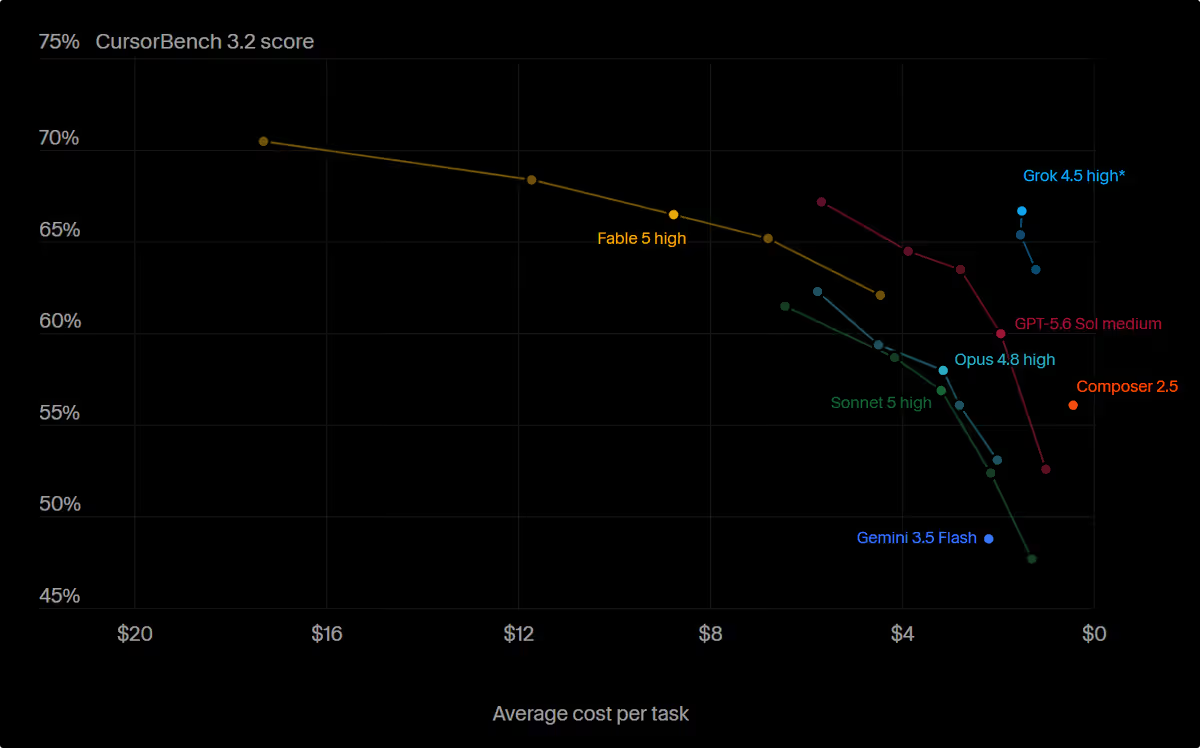 Screenshot: CursorBench — Petralian (2026)
Why work mode changes the right model
| Task shape | Primary risk | Model pressure |
|---|---|---|
| Analysis / synthesis | Wrong sources, shallow brief | Token budget and instruction following |
| Review / audit | Missed defect or false alarm | Reasoning depth vs review fatigue |
| Execution (multi-file change) | Wrong file, wide blast radius | Step count and multi-file score |
| Greenfield | Scaffold drift, rule compliance | Predictable defaults and cost cap |
Execution covers debug and refactor in the benchmark taxonomy. Analysis covers planning and research-style agent sessions in Cursor — briefs, program packs, cross-file synthesis — even when no code ships.
A model that scores 70% on the full battery may still be wrong for routine execution work if it costs ~17 USD and takes 72 steps per task.
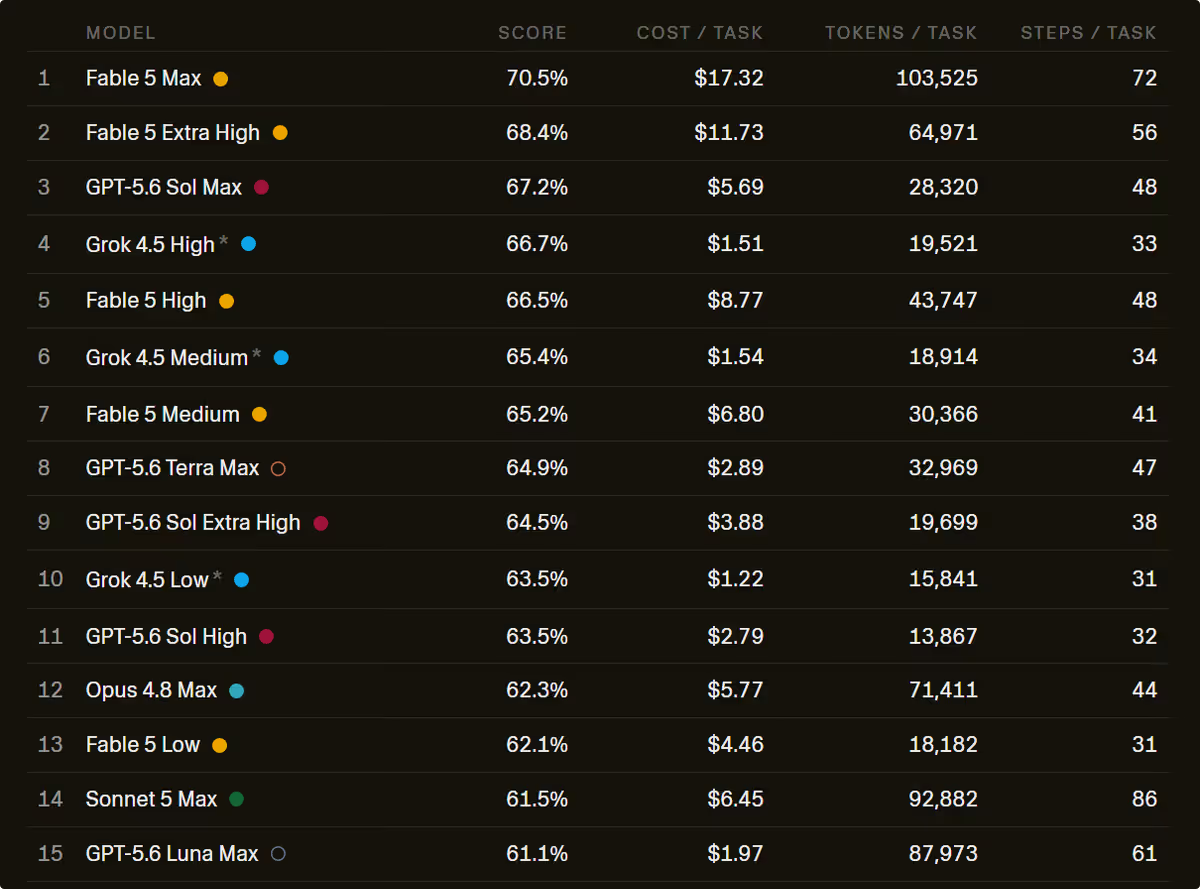
Benchmarked anchors (CursorBench 3.2)
Benchmarked numbers (from CursorBench 3.2):
| Model | Score | Cost / task | Tokens / task | Steps / task |
|---|---|---|---|---|
| Fable 5 Max | 70.5% | $17.32 | 103,525 | 72 |
| Grok 4.5 High* | 66.7% | $1.51 | 19,521 | 33 |
| Fable 5 Medium | 65.2% | $6.80 | 30,366 | 41 |
| Composer 2.5 | 56.1% | $0.44 | 14,286 | 33 |
| GPT-5.5 Medium | 53.8% | $1.51 | 8,522 | 25 |
| GPT-5.5 Extra High | 58.4% | $2.85 | 17,534 | 32 |
| Kimi K2.7 Code | 49.7% | $1.43 | 31,247 | 58 |
| * Grok 4.5: Cursor training-data caveat on evals. |
 Screenshot: CursorBench — Petralian (2026)
Recommended defaults by work mode
These are starting points, not laws. Re-test when CursorBench updates.
| Task | Default pick | Escalation | Why (on public table) |
|---|---|---|---|
| Analysis / synthesis | Composer 2.5 | Fable 5 High or Grok 4.5 High* | Composer balances 33 steps and 56.1% at $0.44; escalate when scope spans many files and failure cost is high |
| Review / audit | GPT-5.5 Medium | Grok 4.5 High* or Fable 5 High | Review is token-sensitive; GPT-5.5 Medium uses 8,522 tokens at 53.8%; escalate when findings must be exhaustive |
| Execution | Composer 2.5 | Fable 5 Medium | Multi-file execution needs score; Medium lands 65.2% at 41 steps without Max pricing |
| Greenfield | Composer 2.5 | GPT-5.5 Extra High | Greenfield rewards rule compliance and cost control; see Composer baseline |
 Screenshot: CursorBench — Petralian (2026)
Work-mode notes
Analysis / synthesis
Research packs, briefs, and cross-file synthesis reward models that stop early on the right sources. High step counts (70+) on the public table often mean agent churn, not thoroughness. Start with Composer 2.5. Escalate when the deliverable is client-facing or the scope spans many files.
Execution
Multi-file execution — implementation, remediation, structural edits — needs coherence across files. Fable 5 Medium is the pragmatic escalation: 65.2% without Max ~17 USD tasks. Grok 4.5 High* is a lower-cost score bump if you accept Cursor's training caveat.
Review / audit
Review sessions read more than they write. GPT-5.5 Medium leads on tokens per task among mid-score models (8,522). Pair with human sign-off on security and compliance findings.
Greenfield
Greenfield work (new initiative shell, new program artifact, new feature outline) punishes model roulette: rules and footers drift. A fixed Composer 2.5 baseline with a tight bootstrap beats swapping frontier models weekly. Escalate to GPT-5.5 Extra High (58.4%, $2.85) when the scaffold is stable and you need a design pass.
Open models and budget tasks
Kimi K2.7 Code is inexpensive ($1.43 per task) but 58 steps for 49.7% on CursorBench 3.2. Use it for exploratory tasks, not program defaults. See open models on CursorBench.
Grok 4.5 on the task map
Grok 4.5 High* scores 66.7% at $1.51 with 33 steps — competitive with Fable High on score at roughly one-sixth the benchmark cost. Cursor flags possible training-data advantage. Treat Grok as an experiment lane for analysis and execution escalation, not a silent default swap.
Limitations
- Aggregate scores hide per-task-type winners until Cursor publishes split columns.
- Harness differences mean SWE-bench leaders may not match Cursor session winners (benchmark comparison).
- Engagement context, file count, and governance rules change real outcomes.
Reader action
- Label your next ten agent tasks as analysis, review, execution, or greenfield.
- Run five on Composer 2.5 and note failures by type.
- Escalate only the failure class using escalation rules.
- Revisit picks when CursorBench publishes a new version.
Weekly email with new posts on enterprise AI and how teams ship it.
One email per week. Unsubscribe anytime.