
TL;DR
- Hong Kong is not short on AI announcements. It is short on customer-resolution quality at tax and banking touchpoints.
- In one afternoon, three institutions—IRD, Standard Chartered, and HSBC—failed the same high-volume intents a call centre handled a decade ago.
- Surveys already show an expectation gap (brands rate AI CX far higher than consumers do). The chat logs explain why.
- Fix the interface before the next press release: intent libraries, authenticated answers, honest escalation, monthly regression tests on the top twenty queries.
The gap is measurable—and visible
Hong Kong talks about AI as industrial policy: 1823 case triage, government LLM pilots, GenAI ambassadors at Customs, mobile HKChat on the roadmap. Banks market 24/7 virtual assistants trained on “hundreds of thousands” of phrasings.
Consumers are not buying the story. A Twilio study reported that 87% of Hong Kong brands rate their personalised engagement as good or excellent, while only 42% of local customers agree—and satisfaction fell year on year. KPMG and GS1 Hong Kong found 28% of Hong Kong consumers trust AI in retail contexts, versus 59% in Greater Bay Area cities. Low trust is rational when the first-line experience still behaves like scripted IVR with an avatar.
Who it is for: service owners, CX programme leads, and executives who approve AI roadmaps in Hong Kong financial services and public digital channels—and need a blunt read on what still fails in production.
What you will learn: a shared failure pattern across three real sessions, how it contrasts with official success metrics, and a five-question audit you can run on any “AI assistant” before the next budget cycle.
Three sessions, one afternoon, zero resolution
The following are observed interactions from July 2026 (PII redacted in screenshots below). They are not penetration tests. They are ordinary questions a resident or cardholder asks every month.
Inland Revenue Department — chatbot “Iris”
Intent: “What is my TIN?” (Taxpayer Identification Number—a core identifier in Hong Kong tax filing.)
What happened: Iris repeated its opening script—“I am Iris. What can I help you with today?”—after the question, twice. When the user expressed frustration, Iris closed with “Hope that helps,” asked for a satisfaction rating, and invited further questions—as if service had been delivered.
Why this matters: IRD launched Iris in April 2021 and stated it was “still in its infancy,” with quality to improve “through learning from interactions with the public.” Five years later, a basic acronym still triggers a greeting loop. That is not a model limitation. It is conversation design debt left unmaintained.
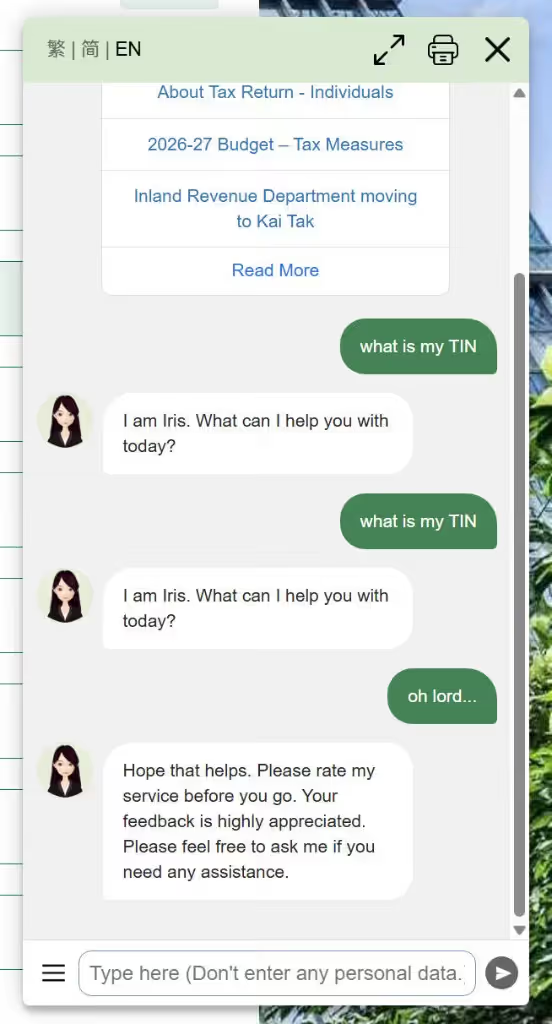 Screenshot: Inland Revenue Department — Chatbot Iris — Petralian (2026); PII redacted; captured July 2026
Standard Chartered Hong Kong — virtual assistant “Stacy”
Intent: Credit card payment due date (asked three ways: “When is my cc bill due?”, “When to pay?”, “Yes, when is the due date?”)
What happened: Stacy returned the outstanding balance on the Cathay co-brand card—not the due date. On the third attempt, the session failed with a generic “Internet connectivity” message and offered Chat with Live Agent (hours-limited).
Context: Stacy runs on Kasisto’s KAI Banking platform, in production since March 2019. Marketing copy promises NLP that “improves all the time.” Confusing balance with due date is classic slot-filling error—the kind regression suites are meant to catch weekly.
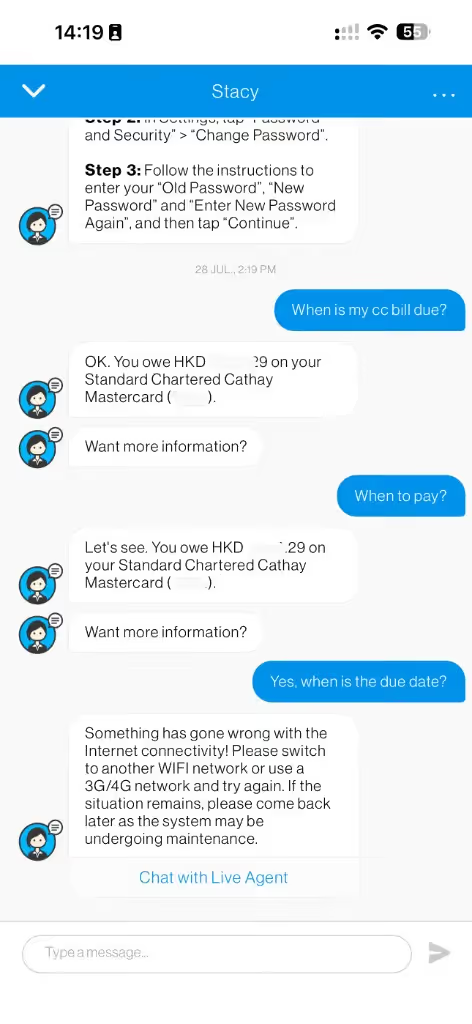 Screenshot: Standard Chartered HK — Chat with Stacy — Petralian (2026); PII redacted; captured July 2026
HSBC Hong Kong — mobile chat
Intent: Same family of query—“When is my credit card due?” then a clearer follow-up including balance and due date.
What happened: “Sorry, I’m not sure I understand. Can you please rephrase?” After a more explicit prompt, the bot offered a category pivot: “Sounds like you’re trying to manage your account”—with Yes / No, go back buttons instead of retrieving account facts.
Why this matters: HSBC is not a fringe player. If the largest retail bank in the market cannot parse due date in natural language inside authenticated mobile chat, the industry’s AI narrative is running on marketing, not measurement.
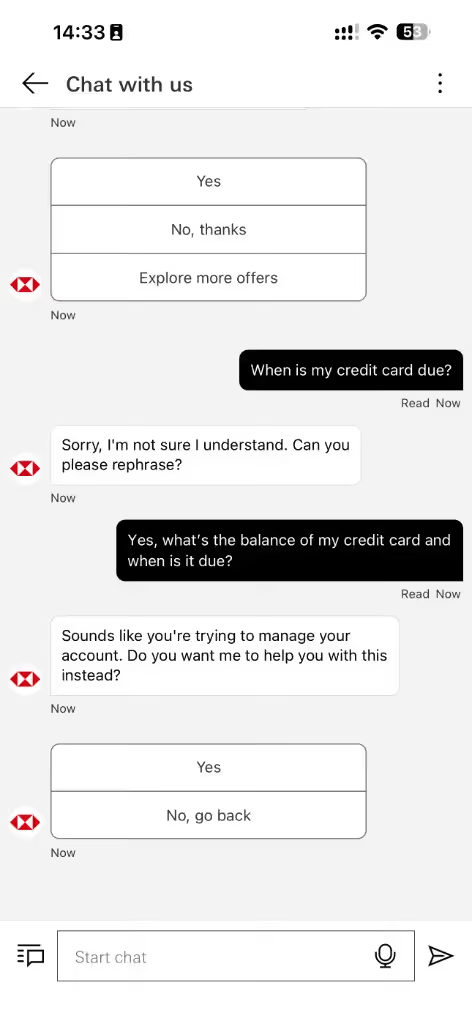 Screenshot: HSBC Hong Kong mobile app — Chat with us — Petralian (2026); PII redacted; captured July 2026
A common failure pattern—not three bad luck incidents
| Failure mode | IRD Iris | StanChart Stacy | HSBC chat |
|---|---|---|---|
| High-volume intent misparsed | TIN → greeting loop | Due date → balance | Due date → “rephrase” |
| Session memory | Ignores prior turn | Repeats wrong answer | Offers button menu |
| Closure behaviour | Rate me after zero help | Blame connectivity | Deflect to “manage account” |
| Likely stack era | 2021 FAQ bot | 2019 KAI NLP | Pre-LLM menu + NLU gap |
These are not edge cases. Payment due date and tax identifiers sit in the top decile of contact-centre volume in any mature market. If AI cannot carry them, the ROI case is deflection theatre—fewer visible humans, not fewer customer problems.
That aligns with KPMG’s retail AI report: satisfaction with chatbots remains weak; trust requires human backup and transparent limits. Hong Kong consumers are telling researchers they do not trust AI; institutions are proving them right at the front door.
The policy stack and the product stack are not the same
Hong Kong can ship modern AI when it chooses. Customs’ “XiaoHui” ambassador (2025) uses RAG over a knowledge base and a local LLM. The 1823 contact centre reports millions of AI-assisted cases and high chatbot resolution rates for Tammy—with scope limited to FAQ-style enquiries and no chat handoff to a human.
The lesson is not “Hong Kong cannot do AI.” It is funding and attention follow visibility:
- Back-office and hotline AI (triage, email parsing, draft responses for staff) improves civil-service throughput.
- Citizen-facing tax and retail banking bots on legacy stacks do not automatically inherit those upgrades.
- Banks imported 2019-era “virtual assistants” and left them on marketing life support while mobile apps still throw server connection errors on the same day.
 Screenshot: Hong Kong financial services mobile app — Petralian (2026); institution unspecified; captured July 2026
Enterprise AI readiness is not a model purchase. It is governance, evals, and ownership of customer outcomes. Hong Kong’s workplace surveys show heavy employee AI use and weak corporate governance (HKPC 2025). Customer channels exhibit the same split: usage without accountability.
What “good” would look like (and what to do this quarter)
A serious customer AI programme in 2026 has four non-negotiables:
- Intent ownership — A named product owner publishes the top 50 intents, expected slots, and API sources (core banking, card processor, tax profile). “Due date” and “TIN” are never “phase two.”
- Authenticated answers — Post-login chat must read the same fields the app already shows. If the app can display a statement date, the bot must not guess balance instead.
- Honest escalation — If confidence is low, route to human or callback in one step. Do not ask for a rating after a loop. IRD’s pattern is the anti-pattern.
- Regression cadence — Weekly automated tests on the top twenty utterances per locale (English, Traditional Chinese, Cantonese phrasing). CX metrics that bind to tickets and repeat contacts—not internal “bot containment rate” alone.
Path A — five questions before your next AI CX budget line
Run this on any Hong Kong chatbot your team ships or buys:
| # | Question | Pass |
|---|---|---|
| 1 | Can it answer due date / minimum payment and tax ID location without menus? | Yes in both EN and Chinese |
| 2 | Does it reuse context from the previous turn? | No greeting loop |
| 3 | On failure, does it escalate without blaming the user’s network? | Yes |
| 4 | Is there a named owner for intent accuracy (not only “IT project”)? | Yes |
| 5 | Do you measure repeat contact within seven days for bot-handled sessions? | Yes |
Fail three or more and the channel is cost containment, not AI transformation—regardless of what the press release says.
APAC context without excuses
Hong Kong is not alone in lagging retail on digital experience; retail has often out-innovated banking on customer-facing speed. But Hong Kong’s trust deficit versus the GBA is specific. Mainland consumers meet AI in payments, recommendations, and service flows more often—and report higher confidence. Hong Kong institutions risk exporting customers’ patience while importing AI slide decks.
Workforce anxiety compounds the picture: APAC entry-level roles are already pressured by automation narratives. Replacing front-line jobs with bots that cannot answer “when do I pay?” trains the public to associate AI with worse service, not faster service.
FAQ
Why do Hong Kong chatbots fail simple questions?
Many deployments are pre-LLM FAQ bots or menu-plus-NLU stacks that cannot resolve multi-step intents (tax IDs, due dates, handoffs). Policy announcements outran product integration.
Did IRD Iris, HSBC, and Standard Chartered Stacy use the same technology?
No. The failure pattern is similar—loops, wrong answers, dead ends—but likely stack eras differ (2021 FAQ bot vs older KAI NLP vs menu gaps).
Are there Hong Kong examples of modern customer AI?
Yes. Customs XiaoHui (RAG over a knowledge base) and 1823 Tammy report high resolution on scoped FAQ-style enquiries—with limits such as no chat handoff to humans on some channels.
What should CX leaders measure instead of AI labels?
Task completion rate, escalation quality, time-to-resolution on real intents, and whether satisfaction prompts appear after help—not vanity "AI-powered" badges.
Is this only a Hong Kong problem?
No. APAC shares the gap, but Hong Kong's policy stack vs product stack split is unusually visible in banking and government touchpoints.
Closing position
Hong Kong does not need another AI strategy deck. It needs retirement dates for pre-2023 customer bots, public regression results on the intents that drive contact volume, and alignment between what LegCo celebrates (1823 throughput) and what a taxpayer sees when they type “TIN” into Iris.
Until then, “AI-powered customer service” in Hong Kong is often a label on infrastructure that would embarrass a 2015 mobile app team. The technology to do better exists in the same city. The missing ingredient is executive ownership of the conversation—not the model card.
Sources
- IRD — Chatbot Iris (2021 launch)
- Standard Chartered HK — Stacy
- Kasisto — Stacy production (2019)
- Twilio / Marketing-Interactive — HK expectation gap
- The Standard — KPMG/GS1 trust gap HK vs GBA
- KPMG — Beyond retail in the age of AI (PDF)
- The Standard — 1823 AI case handling
- 1823 — Tammy chatbot scope
- HK Customs — XiaoHui GenAI (2025)
- HR Asia — HKPC AI Readiness 2025
Weekly email with new posts on enterprise AI and how teams ship it.
One email per week. Unsubscribe anytime.