
TL;DR
- Kyndryl's 2026 People Readiness Report: 57% of enterprises have AI deployed broadly or embedded in core processes; 11% report achieving both of their top two AI goals.
- 32% hit at least one top goal. Efficiency shows up first (38% report improved operational productivity). Revenue and net-new innovation lag (13–14%).
- The bottleneck is not copilot access. 23% of leaders say the workforce is ready for AI, down six points year on year. 33% have fully implemented training for human-AI collaboration.
- APAC mirrors the pattern: high weekly use, thin enterprise scale. Pair Kyndryl with HRM Asia on regional adoption before the next board slide claims victory.
Foundation narrative: Getting enterprise AI right: the work before deployment
Pre-flight diagnostic: Why your AI program may fail before it starts
Who this is for
Program owners, CX leads, and finance partners who need primary-source numbers to compare deployed vs outcome rows in steering decks. You do not need to be a Kyndryl customer to use the survey. You do need to know what 57% and 11% actually measure before you reuse them.
What the 57% and 11% numbers actually measure
Kyndryl's second annual People Readiness Report (released June 2026; fieldwork March–April 2026) surveyed 1,100 senior business and technology leaders across eight countries, conducted by Edelman Intelligence [1]. Half of respondents were C-suite; half represented companies with $1B+ revenue.
The headline deployment figure is precise:
| Deployment state | Share of respondents |
|---|---|
| AI deployed broadly across the enterprise | 35% |
| AI embedded in core business processes | 21% |
| Combined (the widely quoted 57%) | 57% |
That is up sharply from 35% who said AI was fully integrated across the organization in the 2025 edition of the same study [1]. Enterprise-wide AI moved from experiment to default in one budget cycle.
The outcome numbers are where the story turns:
| Outcome | Share |
|---|---|
| Achieved at least one of their top two desired AI outcomes | 32% |
| Achieved both top two desired outcomes | 11% |
Kyndryl did not publish a single universal pair of goals. Leaders picked their own top two from a menu that included operational efficiency, customer experience, cost reduction, risk and fraud, revenue growth, IT modernization, and net-new product or service innovation [1]. The 11% band is narrow because it requires both self-selected priorities to show up in production, not a single lucky pilot.
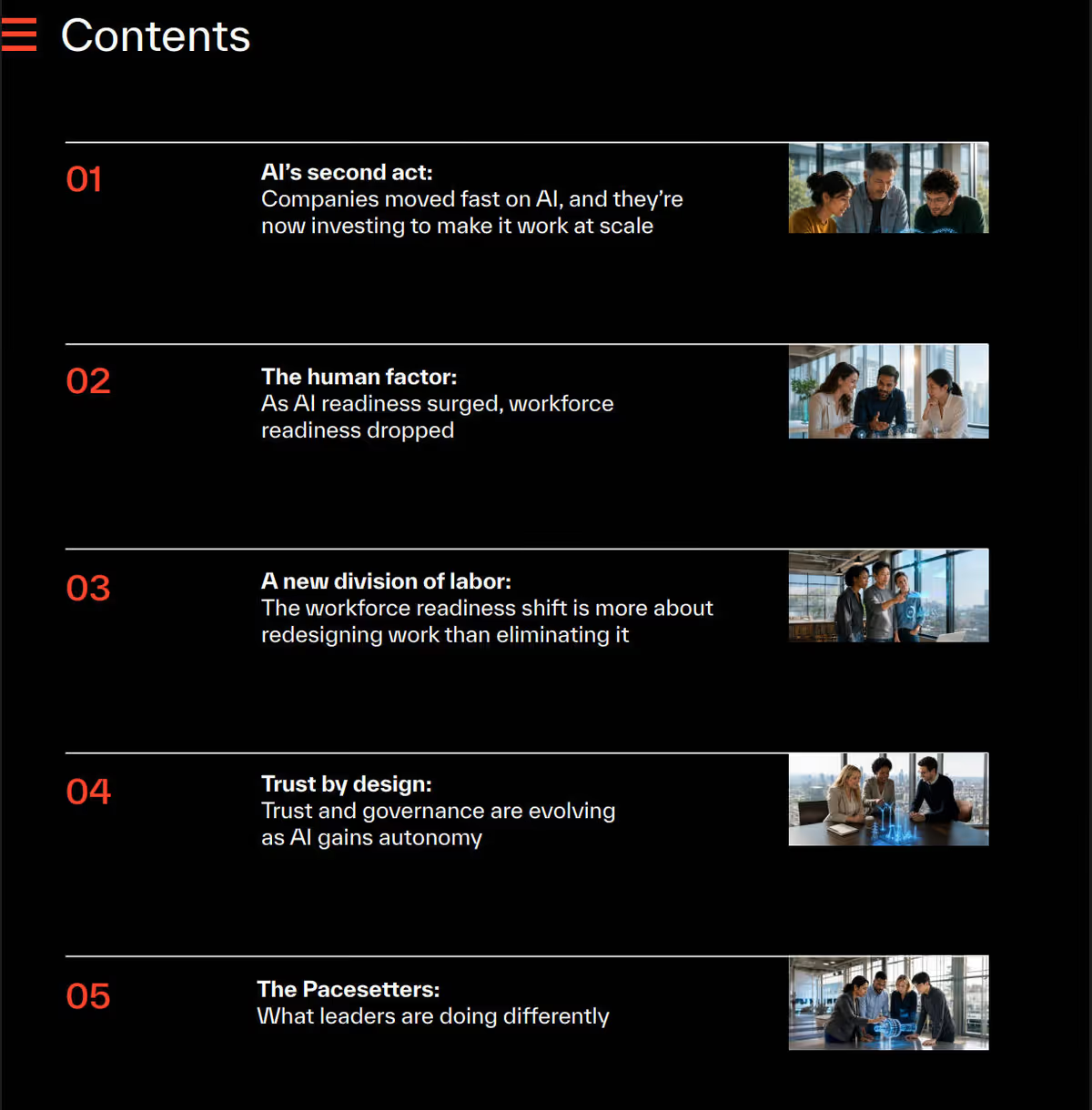 Screenshot: Petralian (2026)
Deployed vs outcomes leadership cares about
Board slides love deployed. Operating committees should love experienced.
Kyndryl's data separates desire from delivery on the most common goals:
| Desired / experienced outcome | Already experiencing (share) |
|---|---|
| Improved operational efficiency and productivity | 38% |
| Improved customer experience | 19% |
| Reduced costs or improved margins | 18% |
| Additional revenue growth through AI-driven innovation | 13% |
| Innovation in new products, services, and business models | 11% |
Efficiency is the early win. Harder commercial outcomes are still rare. That matches the productivity paradox pattern Kyndryl's own commentary flags: technology progress shows up in dashboards before it shows up in the P&L line leadership promised [1].
Many programs show a gap between access and measured outcomes:
- 77% say generative AI is already scaled across multiple functions [1].
- 77% say executive leadership has defined and communicated an AI strategy [1].
- Yet 79% agree AI adoption will outpace their organization's ability to adapt workforce, governance, and operating model [1].
You can buy seats, run town halls, and still miss the outcome row when workflow redesign, measurement, or escalation owners are unnamed.
I wrote the foundation checklist in getting enterprise AI right: data readiness, named governance owners, and change runway are gates before go-live, not parallel work you finish after the demo. Kyndryl's survey is the same argument with different vocabulary: people readiness and operating model, not GPU count.
McKinsey's State of AI 2025 (fieldwork June–July 2025) adds global context: 88% use AI in at least one function, about one-third report scaling across the enterprise, and 39% attribute EBIT impact to AI [2]. Wide use, thin scaling, thin P&L proof. Kyndryl's 57% / 11% pair is sharper because it asks about self-ranked top goals, not generic "we use AI somewhere."
Why APAC usage is high and scaling still lags
Global surveys hide regional texture. APAC often leads on employee experimentation and trails on enterprise scale.
HRM Asia summarizes published research: roughly 78% of APAC knowledge employees use AI at least weekly (BCG figure cited in the piece), while about 7% of organizations have scaled AI across the enterprise (McKinsey figure cited in the same article). High personal use, low institutional absorption.
Hong Kong pushes the usage side further. An HKUST study of 3,722 professionals reported 72.7% using AI daily or weekly versus a 31% global average in that study, while close to 60% had never received formal AI training [3]. Heavy tabs, thin program.
Customer-facing APAC deployments show the same gap from the other direction. In Hong Kong Customer AI Is Still Mostly a Label, I logged three banking and tax chat sessions in one afternoon that failed basic intents. Those systems were deployed. They were not working for the citizen or cardholder. Kyndryl's 19% customer-experience outcome row is consistent with that lived gap.
 Photo: Artem Podrez on Pexels — Petralian (2026)
Operator read: APAC boards often hear "everyone uses ChatGPT." Kyndryl plus regional surveys support a follow-up question: which goal row moved, and who owns the workflow.
The people-readiness checklist before the next board slide
Kyndryl separates IT infrastructure readiness (35% say their org is ready) from workforce readiness (23%, down six points from 2025) and organizational culture (25%) [1]. Technology is not the binding constraint in this sample. People systems are.
Execution gaps the report flags map cleanly to program design:
| Readiness lever | Kyndryl signal | What to put in your program plan |
|---|---|---|
| Skills and training | 33% fully implemented training for effective human-AI collaboration [1] | Named curriculum per workflow, not one-off "AI day" |
| Governance | About two-thirds lack clear policies on prohibited AI actions (2026 foreword) [1] | Published allow/deny list before the next pilot expands |
| Role redesign | More than half report redesigning roles for AI; formal change management still sparse [1] | RACI update when a task moves from human to agent-assisted |
| Sponsorship | Executives overestimate frontline enthusiasm versus IC and entry-level staff [1] | Monthly metric review with workflow owners, not only the CIO |
Diagram: people-readiness gates before production scale; Petralian (2026)
Kyndryl highlights a 9% cluster that redesigned roles, ran change management, and built workforce capability together. That group reports materially higher innovation and revenue outcomes than the rest of the sample [1]. You do not need to copy their org chart. You do need to stop treating training, governance, and workflow redesign as three optional workstreams.
Path A (one afternoon)
Before you paste 57% into a slide:
- Write your org's top two AI goals for the next 12 months (same specificity Kyndryl's respondents used).
- For each goal, name one workflow owner, one metric, and one human sign-off before external use.
- Ask whether training and prohibited-use policy exist for that workflow today, not "for AI in general."
- If any box is blank, your status is deployed, not delivering.
Limitations
- Self-report bias: leaders grade their own progress. Underperformance is likely undercounted.
- Vendor sponsorship: Kyndryl sells transformation services. Read for pattern, not gospel.
- Snapshot: fieldwork closed April 2026. Agent tooling moved again by the time you read this.
- Goal heterogeneity: "Top two goals" differ by company. You cannot benchmark your org to 11% without matching goal difficulty.
- Regional n: India, Japan, and the US had n=200 each; other markets n=100 [1]. APAC-heavy programs should triangulate with local surveys (HRM Asia, Aon APAC, HKUST) before quoting global figures to a Hong Kong board.
Verify every number against your own operating metrics. Surveys start arguments. Your incident log and P&L row settle them.
FAQ
Does 57% mean most enterprises succeeded with AI?
No. It means 57% report AI deployed broadly or embedded in core processes [1]. Deployment is not outcome achievement. Only 11% report both of their top two desired outcomes.
What counts as a "top two goal" in the Kyndryl survey?
Leaders selected priorities from a fixed list including efficiency, customer experience, cost, risk, revenue growth, IT modernization, and net-new innovation [1]. The 11% figure requires both chosen goals to show up as experienced outcomes, not one.
Why did workforce readiness drop while deployment rose?
Kyndryl reports 23% say the workforce is ready for AI, down six points from 2025, while deployment jumped to 57% [1]. Adoption outran training, role redesign, and change management. That is the central tension of the report title.
How does this relate to McKinsey and HRM Asia numbers?
McKinsey State of AI 2025 shows wide use (88%) with thinner scaling and EBIT attribution [2]. HRM Asia cites 78% weekly employee use in APAC against 7% enterprise scale [4]. Different methods, same shape: access and pilots ahead of measured outcomes.
Is Kyndryl saying technology does not matter?
No. 35% cite IT infrastructure as ready, still higher than workforce or culture [1]. The point is that technology readiness alone does not predict goal achievement. People and operating model gaps dominate the lower outcome rows.
What should I do before the next steering committee?
Run the Path A checklist above. If you need a shorter gate list, use why your AI program may fail before it starts.
What to do next
Download the Kyndryl 2026 People Readiness Report PDF and highlight the 57%, 32%, and 11% rows. Bring them to your next review as a question set, not a scorecard: which of your top two goals has a named owner, a metric, and a training plus governance path that is already live?
If you cannot answer that for both goals, you are in the 57% deployment cohort. You are not yet in the 11% outcome cohort. Close that gap before you buy more seats.
Sources
- Kyndryl, 2026 People Readiness Report (June 2026), insights article and PDF; press release.
- McKinsey & Company, The State of AI (November 2025; global survey fieldwork June–July 2025), cited in Getting enterprise AI right.
- HRM Asia, "Employees in Hong Kong are among the world's heaviest users of AI…" (August 2026), HKUST study summary, hrmasia.com.
- HRM Asia, "Nearly eight in 10 employees in APAC use AI weekly. Only 7% of firms have scaled it," hrmasia.com (BCG and McKinsey figures as cited in article).
Weekly email with new posts on enterprise AI and how teams ship it.
One email per week. Unsubscribe anytime.