
TL;DR
- GEO is passage-level clarity for retrieval and citation, built into how you write pages machines and humans both read.
- Treat it as site legibility: answer capsules, extractable tables, honest limits, and internal links that help machines map your expertise.
What GEO is in 2026
Generative engine optimization (GEO) is the practice of making web content easy for retrieval systems to chunk, rank, and quote inside synthesized answers. It complements SEO: write passages that stand alone, state limits honestly, and structure comparisons so a model can extract them without inventing your position.
Who it is for: content strategists, SEO leads, and founders who hear "optimize for ChatGPT" and need a decision framework that survives the next product rename.
What you will learn: how GEO differs from classic SEO and from AIO (brand-wide AI discoverability), what "site legibility" means in practice, and one afternoon test you can run in any chat tool.
 Photo: Ahmet Polat on Pexels — Petralian (2026)
Why the ChatGPT framing misleads buyers
Vendor decks often sell GEO as "rank inside ChatGPT." That framing pushes teams toward prompt stuffing, hidden FAQ blocks, and duplicate pages tuned for one interface. Retrieval systems do not share one ranking file. Google AI Overviews, Perplexity, Gemini, and enterprise copilots each combine crawl data, freshness signals, and passage scoring differently (Google Search Central on AI features).
The durable bet is older than any single chat product: useful content with clear structure. Research on generative retrieval emphasizes self-contained segments a model can lift without surrounding context (Princeton GEO study, arXiv:2311.09735). Google's guidance for AI features in Search still rests on familiar foundations (Google Search Central — AI features).
If your GEO program only produces "AI summary" paragraphs that repeat the H1, you added words without adding extractable judgment. Worse, you train internal teams to chase interface rumors instead of fixing the pages customers and crawlers already hit.
SEO, AIO, and GEO on one page
| Layer | Question it answers | Primary job |
|---|---|---|
| SEO | Can users find this URL in classic search? | Titles, crawlability, intent match, links |
| AIO | Is the brand coherent across surfaces machines read? | Taxonomy, entity consistency, freshness, E-E-A-T signals |
| GEO | Can a passage be quoted without distortion? | Answer capsules, tables, definitions, stated limits |
These overlap. A strong SEO page with thin sections fails GEO. A GEO-perfect FAQ on a site with broken metadata still fails SEO. My earlier piece on LLMs and search tracked the shift from blue links to synthesized answers; GEO is the editorial discipline that makes synthesis safer for you.
Screenshot: Petralian (2026)
What site legibility looks like
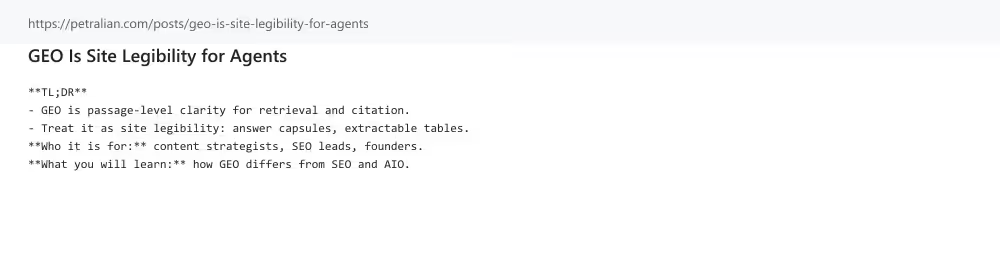
Screenshot: answer capsule on a published post — Petralian (2026)
Legibility is editorial choices that reduce ambiguity for a machine reader: passage shape and extractable structure, ahead of keyword density.
Answer capsule in the first screen. State problem, audience, and outcome in plain language before the nav block grows. Models and humans both benefit; this is the same discipline I use in marketing voice governance for extractable openings.
One idea per H2 block. Each section should teach the next layer, not restate the thesis. Repeating the same slogan under every heading adds tokens, not trust.
Tables and role matrices. Comparisons (SEO vs AIO vs GEO, advisory vs commit, channel vs engine) give models structured facts to quote.
Named limits. Content that states what it does not cover earns more citation trust than content that claims universality.
Internal links with intent. Two or three links to related posts help retrieval systems cluster your expertise. Random footer links do not.
 Screenshot: Petralian (2026)
Common GEO mistakes
| Myth | Reality |
|---|---|
| "Hidden paragraphs for bots" | Crawlers and policies penalize cloaking patterns |
| "Duplicate every post for Perplexity" | Passage quality beats URL sprawl |
| "Ignore SEO because answers are zero-click" | Many citations still resolve to URLs |
| "GEO replaces brand voice" | Voice systems and GEO both need machine-readable specs |
GEO also does not replace the file-based memory work you do inside agent sessions. Public legibility and private session continuity solve different layers of the same amnesia problem.
Example implementation: how I run it on petralian.com
I treat each long post as a retrieval unit, not a narrative scroll. Frontmatter carries focus_keyword, seo_description, format, and tags so sync scripts emit consistent metadata. Body drafts go through a Writing Session Guide checklist: answer capsule, one diagram or comparison table, limitations section, and Path A for readers who will never open my vault.
I do not maintain separate "GEO pages." I refresh date and the opening capsule when tools or facts change materially. Numbers that must stay consistent live in data/*.yaml in the repo, not in prose alone.
Path A: test legibility this afternoon
 Photo: cottonbro studio on Pexels — Petralian (2026)
You do not need my stack. Pick one published page you care about (product, policy, or pillar article).
- Paste the first 200 words into any chat tool. Ask: "Summarize who this is for and what action it recommends."
- Paste one H2 section alone. Ask: "What claim does this section make? What evidence supports it?"
- If the model invents audience, stakes, or numbers, fix the passage, not the prompt.
Repeat after you add a comparison table or a limits paragraph. Legibility improvements show up as fewer invented qualifiers in the summary.
Limitations
GEO cannot force citation. Engines omit sources, merge competitors, and paraphrase aggressively. Legibility raises the odds your wording survives intact; it does not guarantee placement.
Highly regulated claims still need legal review. Clear structure does not make an unsubstantiated claim safe.
Freshness matters. A perfect 2024 capsule on a deprecated product hurts trust. Budget time to update openings when the underlying offer changes.
FAQ
What is GEO versus SEO?
SEO earns clicks in classic search. GEO (generative engine optimization) optimizes passages that AI answers quote without distortion—self-contained capsules, tables, and stated limits.
What does site legibility mean for agents?
Machines can find consistent entities, taxonomy, and extractable sections across your site—not hidden facts in images or chat-only memory.
Is GEO just optimizing for ChatGPT?
No. Retrieval differs per engine (Google AI Overviews, Perplexity, Gemini, enterprise copilots). Legible structure survives product renames better than prompt stuffing.
What is an answer capsule?
The first 150–200 words after nav: problem, audience, and outcome in one extractable block a model can cite alone.
How do I test legibility in an afternoon?
Paste one H2 section into any chat tool and ask it to summarize without the rest of the article. If the summary invents facts, the section is not legible enough.
What to do next
Audit your top ten URLs by traffic or revenue. For each, run the Path A paste test. Fix the worst two passages before you buy a GEO tool. Then align SEO metadata and GEO structure in one editorial pass so you are not maintaining parallel content farms.
If your team already runs a voice guide for agents, extend the same "machine-readable spec" mindset to public pages. Marketing voice at scale covers private generation; this post covers what strangers and retrieval systems read on the open web.
Weekly email with new posts on enterprise AI and how teams ship it.
One email per week. Unsubscribe anytime.