External Memory Series — File-based memory for AI-assisted work (overview · 1 Implementation · 2 Productivity · 3 vs the diagram · 4 Governance) In the midst of digital transformation, we're witnessing a seismic shift in how users discover content online. As someone who has led Marketing, Ecom, SEO and AI implementation strategies for global brands like Shiseido and worked extensively with emerging technologies, I've observed firsthand how large language models (LLMs) are fundamentally changing the search landscape-and with it, traditional SEO practices that have dominated digital marketing for decades.
What is AI-era SEO?
AI-era SEO is optimizing for large language models and answer engines—entity clarity, authoritative structure, and helpful content—alongside classic search rankings as discovery fragments across chat, snippets, and links.
Who it is for: SEO leads, content strategists, and founders relying on organic discovery.
What you will learn: how LLMs change query behavior; what still matters in technical SEO; and how to future-proof content for answer surfaces.
TL;DR
- What AI Revolution: How LLMs Are Reshaping Search and the Future of SEO covers.
- Who it is for and when to use it.
- Practical next steps after reading.
The New Paradigm of Content Discovery
The traditional model of search-typing a query and clicking through "blue links"-is rapidly being replaced by AI-powered tools that aggregate and synthesize information directly. Instead of users navigating to various websites, AI assistants like DeepSeek, ChatGPT, Claude, Perplexity to name a few do the heavy lifting, delivering comprehensive answers in seconds.
This shift is more than theoretical. According to recent data from Similarweb, traffic to knowledge-based platforms like Stack Overflow has declined by nearly 14% since the widespread adoption of AI assistants began, indicating a clear change in user behavior patterns.
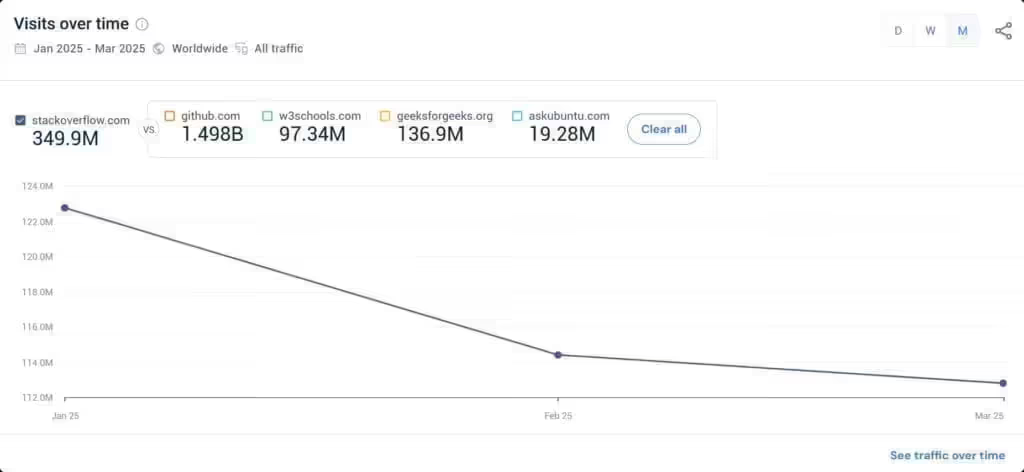 Screenshot of
 From SEO to AIO: The New Frontier
Having implemented custom machine learning models for brands like Shiseido, I've seen how AI is reshaping marketing strategies. The emergence of AI Optimization (AIO) represents the next evolution in digital visibility:
- Content Structure Requirements: Unlike traditional SEO, which focuses on keywords and backlinks, AIO prioritizes machine-readable content that can be easily processed and synthesized by AI models.
- Semantic Relevance: Creating highly authoritative, specific content that demonstrates clear expertise becomes paramount for AI visibility.
- Data-Driven Approach: According to a Stanford HAI study, LLMs prioritize content that demonstrates statistical reliability and structured information presentation, requiring a shift in content creation methodologies.
Strategic Implications for Businesses
When leading digital transformation initiatives for clients across multiple markets, I've always emphasized adaptability. This AI revolution demands exactly that:
Challenges to Address
- Attribution Issues: AI tools often synthesize information without clear attribution, potentially undermining brand recognition.
- Traffic Reduction: The Reuters Institute Digital News Report suggests that websites could see up to 30% reduction in discovery-based traffic as AI assistants become primary information sources.
- Monetization Concerns: Traditional traffic-based revenue models may require significant restructuring.
Opportunities to Leverage
- Structured Data Implementation: Companies investing in schema.org markup and other structured data formats will gain advantages in AI visibility.
- AI Partnerships: Forward-thinking organizations are already developing direct relationships with AI platforms to ensure their content receives appropriate visibility.
- Content Transformation: Shifting from quantity to quality-focusing on creating definitive, authoritative content in your specific domain.
Practical Steps Forward
My experience implementing AI-driven solutions across industries has taught me that practical approaches yield the best results:
- Audit Your Content for AI-Readiness: Evaluate how well your existing content would be interpreted by LLMs, focusing on clarity, structure, and authority signals.
- Develop AIO Expertise: Just as SEO became a critical marketing function, AIO skills will become indispensable. According to Gartner research, 75% of organizations plan to hire or develop AI-specific expertise in their marketing departments by 2025.
- Experiment with Structured Data Formats: Begin implementing various structured data schemas to determine which most effectively boosts AI visibility for your content.
- Diversify Discovery Channels: Don't abandon traditional SEO, but recognize it's becoming just one component of a broader content discovery strategy.
Additional detail
Looking Ahead: The Hybrid Future
While you no doubt will find posts with declarations that "SEO is dead," my experience suggests a more nuanced reality. We're entering a hybrid era where both traditional search and AI-assisted discovery will coexist, with their relative importance shifting over time.
The businesses that will thrive are those that adapt quickly, developing parallel strategies for both channels while constantly measuring and optimizing their approaches based on real user behavior.
Having led teams through multiple technological transitions, I believe this AI revolution offers tremendous opportunities for those willing to embrace change and rethink their content strategies for an AI-first world.
If you're navigating this transition in your organization and want to discuss specific AI optimization strategies tailored to your industry, I'd be happy to share more detailed insights from my experience implementing these solutions.
Myth vs reality (AI marketing)
| Myth | Reality |
|---|---|
| "SEO is dead because of ChatGPT" | Discovery is fragmented, not eliminated—authority still wins |
| "LLMs replace Google entirely" | Hybrid search + chat behavior persists for years |
| "AI content farms win at scale" | Thin volume without trust gets filtered out |
| "Technical SEO no longer matters" | Crawlability and performance still gate visibility |
| "One blog post can rank for everything" | Topic clusters and entity depth matter more |
Common mistakes (AI-era SEO)
| Mistake | Symptom | Fix |
|---|---|---|
| Keyword stuffing for bots | Penalties and poor AI citations | Write clear entities, definitions, and evidence |
| Ignoring E-E-A-T and sources | AI skips low-trust pages | Show expertise with citations and author depth |
| Chasing only featured snippets | Single-surface dependency | Diversify for chat, video, and community answers |
| Deleting legacy content blindly | Lost long-tail authority | Refresh or consolidate with redirects |
| No brand entity strategy | AI cites competitors by default | Build recognizable brand-topic associations |
FAQ
How do LLMs change keyword strategy?
Focus on questions, entities, and intent clusters—not single exact-match phrases.
Should I block AI crawlers?
Usually no for discovery; use robots guidance and monitor citation quality instead.
What content format wins in answer engines?
Clear headings, direct answers, tables, FAQs, and sourced claims.
How fast will SEO shift?
Incrementally channel-by-channel; start adapting now without abandoning proven fundamentals.
Does AI-generated content rank?
Only when edited, accurate, distinctive, and aligned to demonstrated expertise.
Weekly email with new posts on enterprise AI and how teams ship it.
One email per week. Unsubscribe anytime.