Agent workflows that capture live UI into skill files or context bundles solve a real problem: the model sees what you see. They also create a new trust boundary. Anything in the DOM can become instructions if you paste outerHTML verbatim into a prompt.
I treat design capture the same way I treat user-generated content in a CMS: sanitize before the agent reads it.
The problem: DOM as prompt payload
A typical flow:
- CLI or browser extension selects a component.
- Tool serializes outerHTML, computed styles, or accessibility tree.
- Output lands in SKILL.md, a canvas file, or chat context.
- Agent follows "design system rules" embedded in hidden nodes or aria labels.
Attack or accident paths include:
display:noneblocks with "ignore previous instructions"- Data attributes copied from staging CMS with editorial notes
- Third-party widget markup with marketing copy the agent interprets as commands
Why this matters for builder teams
Design capture accelerates UI parity work. One polluted capture can steer an agent to delete auth guards, swap API endpoints, or hardcode staging URLs across a repo.
The failure mode is subtle because the skill file looks like a legitimate design reference.
Sanitization gate at capture time
Practical rules:
- Remove script, iframe, template, and svg foreignObject unless explicitly needed.
- Drop elements with
hidden,aria-hidden=true, ordisplay:nonein computed style. - Allowlist attributes: class, role, href, src, alt, data-testid. Strip data-* editorial fields.
- Truncate text nodes to N characters per element; agents need structure, not full marketing copy.
- Hash the sanitized output and log it in the skill header so drift is visible in git diff.
Separate design tokens from narrative
Prefer capturing:
- CSS variables and token JSON
- Component prop interfaces
- Screenshots with redacted text
Avoid dumping entire marketing pages into skills. Section-level capture beats page-level capture.
Human review hook
For high-risk repos, require a human ack line in the skill file footer: reviewed_by: human, date: ... before agents use it in autonomous mode.
Additional detail
Testing the sanitizer
Maintain a fixture file of malicious and noisy HTML snippets. Your capture CLI tests should assert:
- Injection strings in hidden divs never appear in output.
- Allowed components still preserve class names and layout hierarchy.
- Output byte size stays under a ceiling so skills do not bloat context.
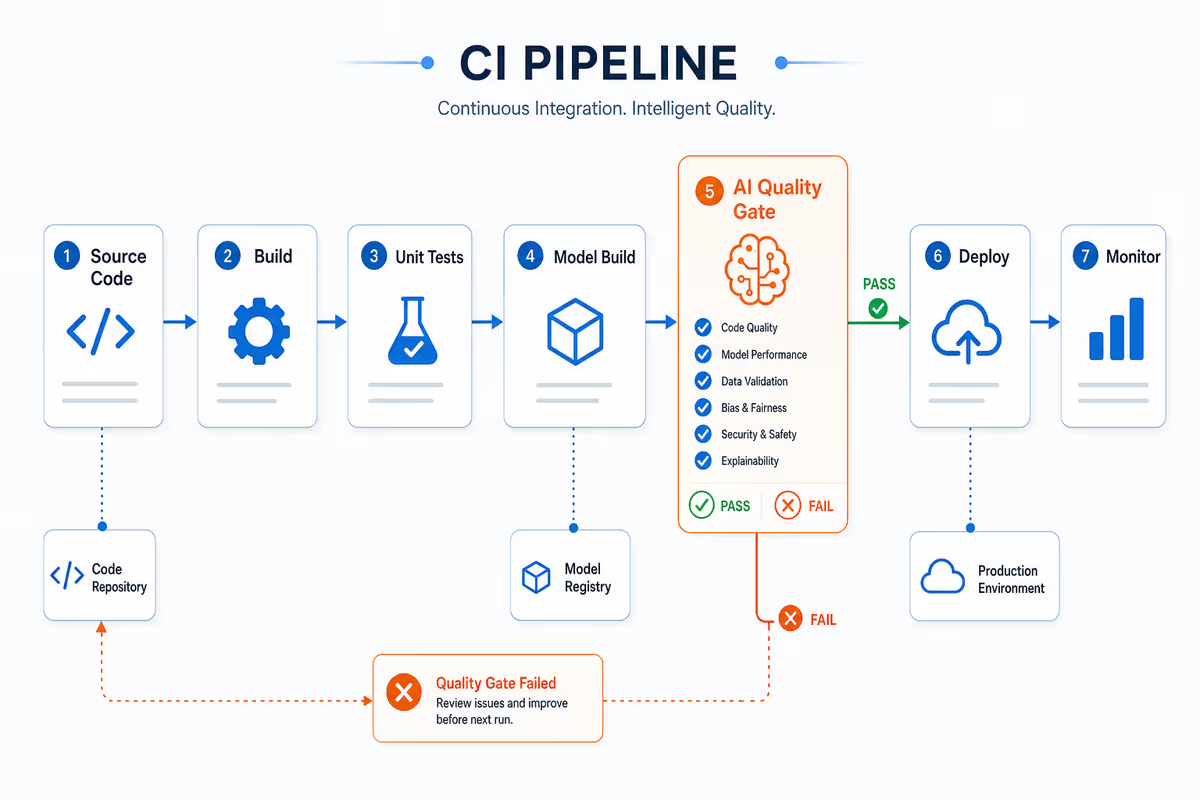
Run the fixture in CI on every change to the capture tool, not only on agent prompt changes.
What is the UI capture prompt injection risk?
The UI capture prompt injection risk is the chance that untrusted DOM content—hidden nodes, data attributes, third-party widgets—gets serialized into SKILL.md or agent context and interpreted as instructions. Design capture tools that paste outerHTML verbatim create a new trust boundary: the DOM becomes prompt payload unless sanitized at capture time.
TL;DR
- Design capture CLIs that dump outerHTML into SKILL.
- md files can smuggle instructions.
- Sanitize at the trust boundary before agents read the DOM.
Reference
Quick reference: sanitization rules
| Rule | Action |
|---|---|
| Strip risky tags | Remove script, iframe, template, foreignObject unless needed |
| Drop hidden nodes | hidden, aria-hidden, display:none |
| Allowlist attrs | class, role, href, src, alt, data-testid |
| Truncate text | Cap characters per element; structure over marketing copy |
| Hash output | Log sanitized hash in skill header for git diff visibility |
Additional detail
Common mistakes (design capture for agents)
| Mistake | Symptom | Fix |
|---|---|---|
| Pasting production outerHTML raw | Agent follows hidden instructions | Sanitize at capture boundary |
| Page-level capture | Bloated context + injection surface | Section-level or component-level capture |
| Mixing narrative with tokens | Marketing copy becomes commands | Separate tokens JSON from HTML dumps |
| No fixture tests for sanitizer | Regression on CLI changes | CI fixtures with malicious HTML snippets |
| Skipping human review on high-risk repos | Autonomous mode with polluted skills | reviewed_by footer before agent use |
FAQ
Why is hidden DOM text dangerous for agents?
Models treat skill file content as authoritative context. display:none blocks or CMS editorial attributes can smuggle "ignore previous instructions" into otherwise legitimate design references.
What should I capture instead of full pages?
CSS variables, token JSON, component prop interfaces, and redacted screenshots—not entire marketing pages.
How do I test the capture CLI?
Maintain malicious HTML fixtures; assert injection strings never appear, allowed structure preserved, and output size stays under a ceiling.
Is staging safer than production for capture?
Not automatically—staging CMS notes and widgets can carry the same injection paths. Treat every source as untrusted.
Where does this connect to quality governance?
Pair bounded capture with agent quality monitoring and CI gates when capture tools feed autonomous workflows.
What you can do next
- Audit existing SKILL.md files for raw HTML pasted from production pages.
- Add a sanitizer step to your capture CLI with tests for injection strings.
- Document which sites are safe to capture from (staging vs prod).
- Run a red-team string through a hidden div and confirm it never reaches the agent context.
Useful design capture is bounded capture. Treat the DOM as untrusted input.
Store captures in version control so diffs show when a hidden node appeared between sessions. Agents are not the only readers of skill files. Humans auditing injection risk need readable git history too. Treat every capture export as a security review artifact.
Sources
- OWASP, "Prompt injection." https://owasp.org/www-project-top-10-for-large-language-model-applications/
Weekly email with new posts on enterprise AI and how teams ship it.
One email per week. Unsubscribe anytime.