External Memory Series — File-based memory for AI-assisted work (overview · 1 Implementation · 2 Productivity · 3 vs the diagram · 4 Governance)
The New CI Gate: Failing Builds on Agent Quality
Most teams already gate releases on tests, lint, and security checks. That is necessary, but no longer sufficient when AI agents contribute to product behavior.
AI can regress while classic checks still pass.
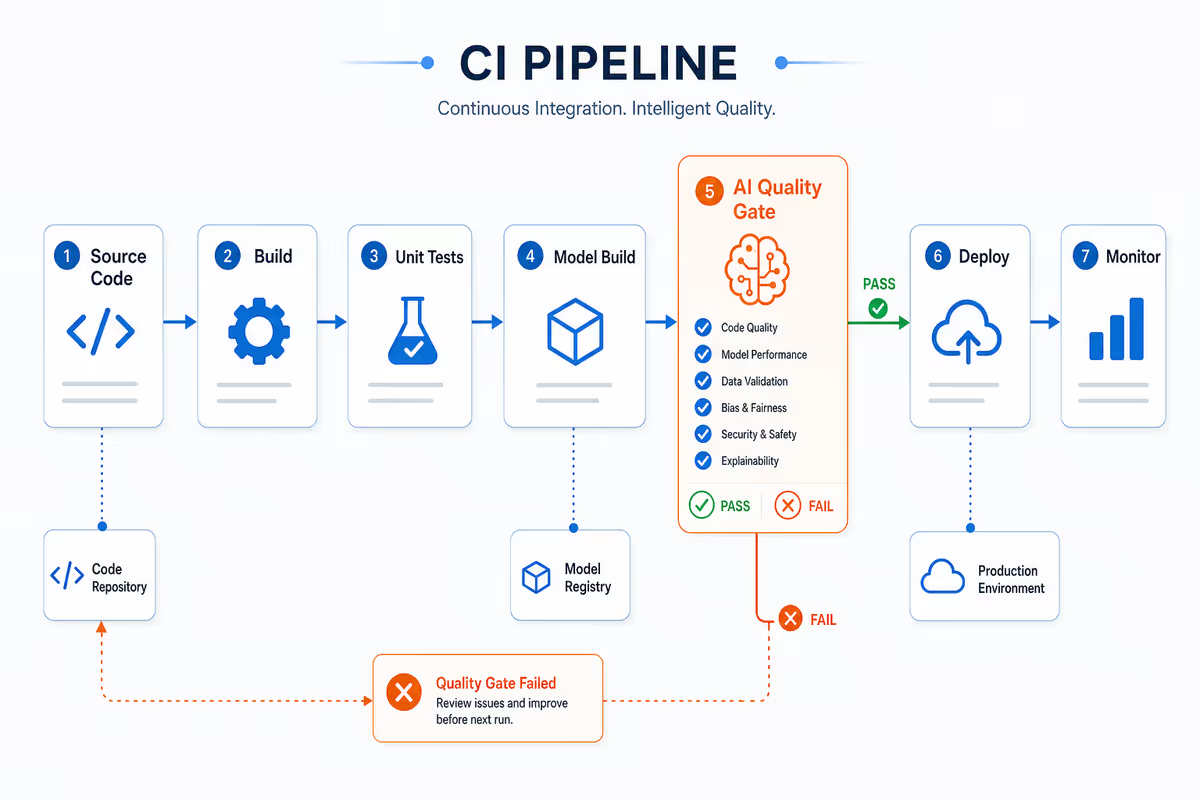
If quality scores are visible but non-blocking, teams often ship under pressure anyway. The fix is simple in concept: make AI quality a gate, not just a dashboard.
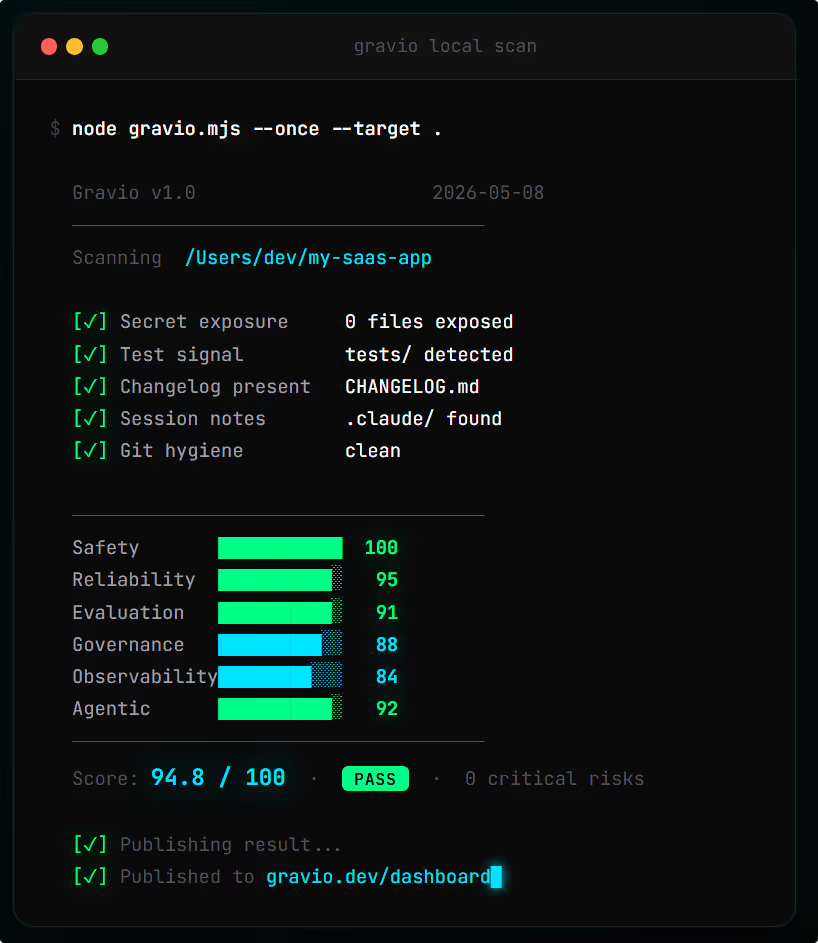 Screenshot: Petralian / GitHub (2026)
Why Existing Gates Miss AI Regressions
Traditional gates answer deterministic questions:
- Does the code compile?
- Do tests pass?
- Are dependencies safe?
AI quality needs additional questions:
- Did output quality drop below acceptable threshold?
- Is trend direction worsening across recent runs?
- Did a key dimension regress significantly?
Without these checks, you can ship a "green" pipeline with degraded user-facing behavior.
What a Useful AI Quality Gate Looks Like
A practical gate usually includes:
- Minimum total score threshold.
- Maximum allowed regression delta against baseline.
- Optional dimension-level floors for critical categories.
- Clear pass/fail output in CI logs.
This does not need to be complex to be valuable.
Implementation Pattern
- Generate or fetch the latest quality score for the target branch.
- Compare against policy thresholds.
- Exit non-zero when policy is violated.
- Surface actionable context in CI output.
The key is consistency. A gate only changes behavior if it is predictable and enforced.
Policy Design Tips
Start with guardrails, not perfection
Set thresholds that prevent obvious regressions first. Tighten over time as your process matures.
Version your policy
Treat thresholds like code. Changes should be reviewed and traceable.
Avoid subjective override culture
If every failure can be waived informally, you do not have a gate; you have a suggestion.
Where This Fits in the Adoption Journey
The best sequence is:
- Onboard quickly with From Empty Folder to First Quality Score in 10 Minutes.
- Monitor drift with Why AI Agent Output Quality Drifts Over Time.
- Enforce thresholds in CI.
- Scale governance via Team Playbook: Rolling Out Gravio Across Multiple Repositories.
If security concerns are slowing adoption, frame the rollout with Zero-Knowledge AI Quality.
Additional detail
What is an AI quality CI gate?
An AI quality CI gate is a blocking release check that fails the pipeline when agent output quality drops below policy—minimum score, regression delta, or critical dimension floors—not merely when unit tests pass. It turns quality from a dashboard suggestion into an enforced decision at merge or deploy time.
TL;DR
- Unit tests catch code failures.
- They do not always catch AI quality regressions.
- Here is how to add quality thresholds as a first-class release gate.
Reference
Quick reference: gate policy components
| Component | Purpose |
|---|---|
| Minimum total score | Floor for acceptable overall quality |
| Regression delta | Max drop vs rolling baseline |
| Dimension floors | Critical categories cannot slip alone |
| Pass/fail CI output | Predictable, actionable log context |
Common mistakes (AI quality gates)
| Mistake | Symptom | Fix |
|---|---|---|
| Gates before stable baselines | Backlash, waived failures | Establish drift visibility first |
| Subjective override culture | Every failure waived informally | Version policy like code; limit exceptions |
| Perfection thresholds on day one | Noise blocks shipping | Start with guardrails; tighten over time |
| Non-blocking scores | Silent regressions in production | Exit non-zero on policy violation |
| No dimension-level floors | High average hides critical misses | Add floors for safety and eval categories |
FAQ
Why don't unit tests catch AI regressions?
Unit tests answer deterministic behavior. AI quality is partly probabilistic and contextual—scores, trends, and category regressions need separate signals.
What is a sensible first threshold policy?
Prevent obvious regressions first: minimum score, max regression delta, optional critical dimension floor. Tighten as baselines mature.
Should gate policy live in repo or centrally?
Version it like code—reviewed, traceable changes. Org baseline with bounded per-repo overrides for multi-repo rollouts.
How does this fit the Gravio adoption sequence?
Onboard → monitor drift → enforce CI gates → scale via multi-repo playbook.
What if security slows adoption?
Frame rollout with zero-knowledge scoring so quality gates do not require plaintext centralization.
Additional detail
The Payoff
When AI quality is an explicit gate, release decisions improve:
- Fewer silent regressions reach production.
- Teams get shared language around acceptable risk.
- Quality becomes a managed system, not a vibe.
As AI becomes a bigger part of delivery, this gate moves from optional to foundational.
Do you want to join Gravio as a beta tester or support as an open source contributor? Simply sign up on gravio.dev and email me, I will convert your account to pro.
Weekly email with new posts on enterprise AI and how teams ship it.
One email per week. Unsubscribe anytime.