You publish an article, push to production, and assume Google — and the AI systems people actually ask — will eventually notice. They often do not, or they index the wrong URL from an old WordPress install, or they summarize you from a chat tab that never saw your canonical page.
That gap is not a writing problem. It is a habits and files problem: what runs before commit, what you expose to crawlers, and what you leave for manual judgment.
Who this is for
Anyone with a site worth finding — a founder shipping a company blog, a student documenting a project, a CEO publishing thought leadership, an operator running a Shopify app changelog. You do not need a Semrush retainer to get the basics right.
I run this on petralian.com (Next.js on Vercel, drafts in Obsidian). The same pattern applies if your stack is Hugo, Astro, or a static folder — the principle is automate the boring checks, keep judgment for the words.
The principle
Search engines and AI crawlers read artifacts, not intentions:
sitemap.xmlandrobots.txt— what you allow and where pages livellms.txt— what AI systems are invited to cite (GEO / AIO discovery)- Per-page
seo_title,seo_description, canonical URLs, JSON-LD - Hero
alttext and absolute image URLs in structured data
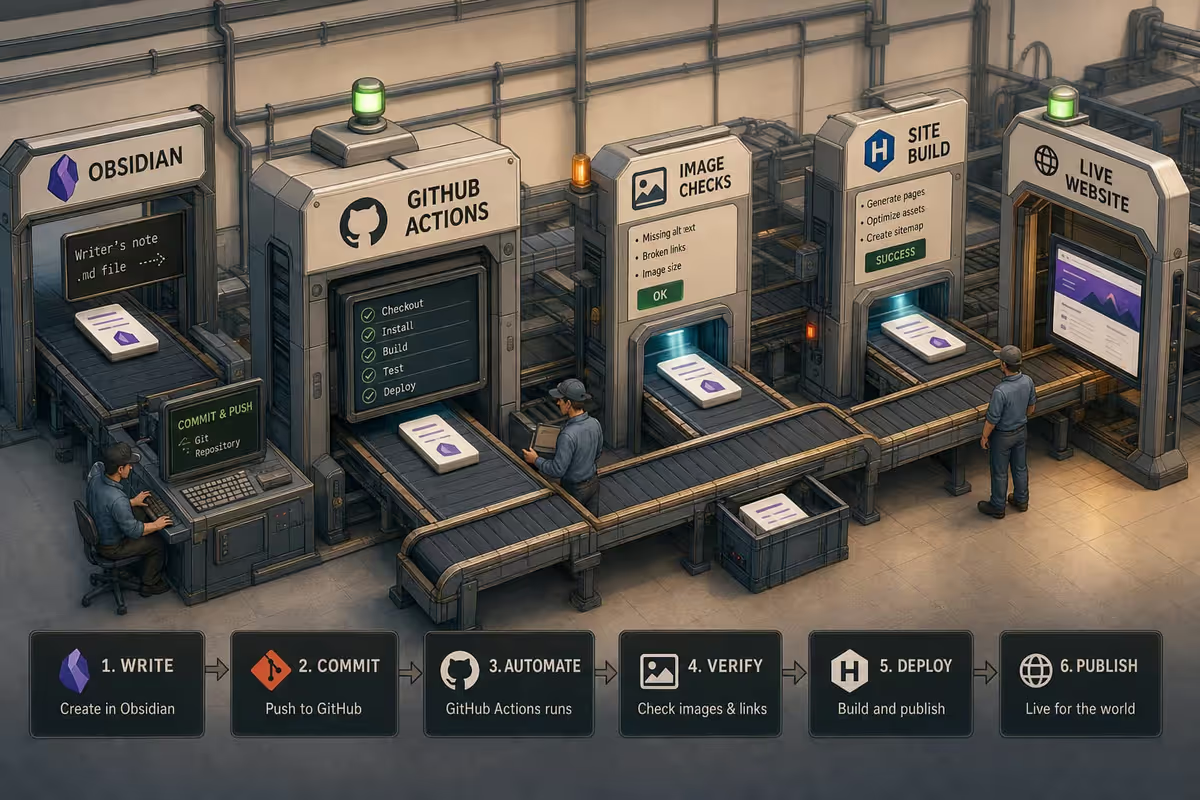
If those files are wrong or missing, no amount of good prose fixes discoverability. So I treat publish like a small CI pipeline: preflight → sync → compress → auto-fix → regenerate discovery files → ping indexes → push.
Example — how I run it
One PowerShell entry point after articles sit in Blog/02 Ready to publish/:
.\scripts\sync-obsidian.ps1 -Preflight # check only.\scripts\sync-obsidian.ps1 # publishThe chain does the following in order:
- Preflight — required
format,best_for, hero file exists; warns on shortseo_titleor missing alt text - Sync — vault markdown →
content/posts/, images →public/images/posts/, strips deprecatedcategory - Image compression —
optimize-images.mjs(non-fatal if Windows locks a file) - SEO auto-fix —
autofix-seo-meta.mjsfills missingseo_description,focus_keyword,featured_image_altwithout rewriting good copy - GEO refresh —
generate-llms-txt.mjsrebuildspublic/llms.txtwith per-post descriptions - Indexing pass —
request-indexing.mjspings IndexNow (Bing/Yandex) and prints Google Search Console URL Inspection links - Git push — Vercel deploys; dynamic
sitemap.xmlandrobots.txtupdate automatically
A GitHub Actions workflow (publish-from-vault.mjs) mirrors the same steps for cloud publish — parity matters so laptop and CI do not disagree.
What I still do manually: Google Search Console URL Inspection (~10–20 requests per day). Google does not offer a simple API key for “request indexing” the way IndexNow works for Bing. I click the links the script prints after each batch.
What changed in one afternoon (2026-07-14)
I shipped a nine-article batch and hardened the pipeline in the same week:
| Layer | Automation |
|---|---|
| Meta debt | Auto-fix ran on 75 posts — missing alt text, titles, descriptions |
| GEO | llms.txt lists every post with a one-line seo_description |
| Schema | BlogPosting uses absolute hero URLs; FAQPage when an article has ## FAQ |
| RSS | Hero <enclosure> on feed items |
| Audits | npm run audit:pre-publish, audit:site, audit:lighthouse |
SEO issues on live posts dropped from 72 → 21 after auto-fix; the remainder need human rewrites (titles too short for legacy pillars), not script patches.
Path A — try the idea in any browser (no IDE)
- Add a plain-text
/llms.txt(or use the llms.txt convention) listing your site sections and article URLs with one-line summaries. - Open Google Search Console URL Inspection for your domain and request indexing on your three most important URLs.
- Register an IndexNow key file at
https://yoursite.com/{key}.txtand POST new URLs after each publish. - Run one lint pass on titles (55–60 characters) and meta descriptions (150–160) before you hit publish.
That alone puts you ahead of most personal sites that only run git push and hope.
Program depth — when the topic earns it
Domain property in GSC: I use petralian.com (domain), not separate www/https properties — one sitemap, one canonical host.
CRM subdomain: Toxic backlink audits hit crm.petralian.com; that host gets robots.txt disallow plus nginx X-Robots-Tag: noindex (server change still pending). Main-site SEO and app-host SEO are different problems — block the app from the index on purpose.
Disavow: I keep a break-glass disavow file but do not upload unless GSC shows a manual action — Links report noise is not the same as a penalty.
Full runbook: vault note [[Operations/SEO Publish Pipeline]] and repo docs/seo/gsc-week1-actions.md.
What I would add next
- GSC Indexing API with a service account (optional; manual clicks work at my volume)
- WebP conversion for oversized PNG heroes (documented in
docs/seo/images-perf-2026-07-13.md) - Pre-commit hook calling
audit:pre-publishon changed slugs only
Bottom line
Publishing is a pipeline, not a single button. Automate what is mechanical — meta gaps, discovery files, IndexNow, link checks — and spend your judgment on openings that work for anyone reading screen one, not on remembering whether tonight's deploy included llms.txt.
If you run a similar stack, start with Path A this afternoon. If you run Obsidian + Next.js, steal the script chain — it is the same "files, habits, judgment" pattern I use for agent memory, applied to being found on the open web.
Weekly email with new posts on enterprise AI and how teams ship it.
One email per week. Unsubscribe anytime.