Knowledge Work Engine Series (Part 2)
Hub: Part 0 · Prior: Part 1 — PM frameworks · Next: Part 3 — Marketing
What is AI leadership governance?
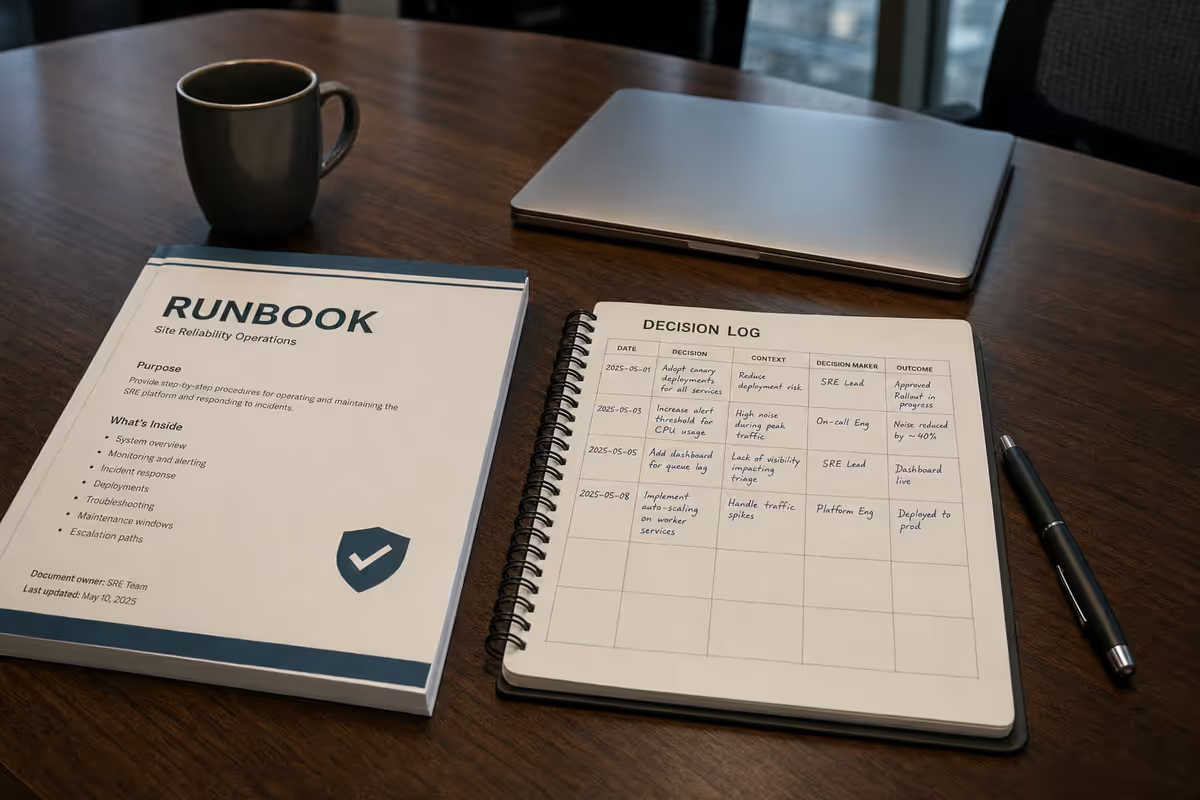
AI leadership governance means keeping purpose, dissent, and accountability in files agents read before they draft memos, options, or emails. The model never becomes Accountable. Leaders use advisory sessions for exploration and commit sessions to record decisions with names and dates.
Who it is for: executives, program directors, and team leads who use AI for SteerCo packs, decision prep, and stakeholder comms.
What you will learn: how Sinek's Golden Circle and Drucker's decision steps map to memory tiers; how RACI assigns agents to R only; and how the memory loop hardens lessons into routing rules.
TL;DR
- Simon Sinek's Why-How-What, Drucker's decision discipline, and RACI meet applied AI.
- Leaders keep accountability; the file-based engine holds purpose, dissent, and decision records agents need at session start.
Getting oriented
How to start with this playbook
Example — how I use this for leadership:
Decisions/folder plus Why-first bootstrap (_Home.mdor charter) before any SteerCo draft. Advisory sessions explore options tables only; commit sessions writeDecisions/YYYY-MM-DD topic.mdwith owner and date. Agent never in the Accountable column.
Full setup: Part 0 — How to get started · Fastest: Path A
| Day one | Action |
|---|---|
| 1 | Add _Home.md or charter — Why in one page |
| 2 | Add Decisions/ + template from Part 0 kit |
| 3 | Add RACI.md — humans in A only |
| 4 | Advisory session: options table only |
| 5 | Commit session: record decision file with owner + date |
The problem: leadership AI without a record is rehearsal
Leaders are told to start with why, make clear decisions, and communicate with consistency. Then they open a chat tab, draft a SteerCo memo, and lose the dissent, the boundary conditions, and the name of who was accountable.
Leadership sessions produce opinions. Organizations need decisions: who decided, what alternatives were rejected, who was informed, when to revisit.
Program delivery (Part 1) already uses Jira for work and Confluence for narrative. Leadership needs a third layer: files that hold purpose, decision rights, and dissent so every AI session starts aligned—not improvising.
This article maps classic leadership ideas (Simon Sinek's Golden Circle, Peter Drucker's decision elements, RACI) to a file-based agent engine and four-tier memory loop. The accountable human stays accountable. The engine holds what chat cannot.
Who this is for
| Reader | Situation |
|---|---|
| Program / product leaders | Running initiatives with AI-assisted briefs and SteerCo packs |
| Functional heads | Need audit trail without another enterprise suite |
| Team leads | Small team, no PMO, but real decisions and stakeholders |
You do not need a custom agent product. You need purpose and decision files your assistant reads before it drafts.
How this relates to your leadership stack
| Layer | Typical tool | Leadership job |
|---|---|---|
| Execution | Jira, OKR tools | Tasks and metrics |
| Published narrative | Confluence, intranet | Policies, reorgs, official announcements |
| Agent engine | Markdown in a knowledge base | WHY/HOW context, dissent, decision drafts, RACI |
The engine does not replace town halls or sign-off chains. It stops the 7am AI session from inventing your why.
Frameworks for purpose and decisions
Golden Circle → memory tiers (Sinek + applied AI)
Simon Sinek argues most organizations communicate outside-in (What → How → Why). Inspiring leaders work inside-out: Why (purpose, belief) → How (values, process) → What (products, deliverables).
Generative AI defaults to What—slides, emails, bullet lists. Without files, it never holds the Why across sessions.
| Golden Circle | Engine mapping | Example file |
|---|---|---|
| Why | Layer 3 evergreen | _Home.md purpose, initiative charter, messaging-pillars.md |
| How | Layer 4 rules + Layer 2 routing | WORK-ROUTING.md, RACI.md, advisory vs commit |
| What | Layer 2 operational + execution tools | Bridge.md, Jira epics, Decisions/ outcomes |
Memory loop (Layer 4 → Layer 1): When a retrospective or SteerCo changes the Why, update _Home.md and link the session in Lessons-Learned.md. Next agent session inherits the new purpose—not last week's chat tone.
Golden Circle mapped to engine (diagram in any tool; D2 below for petralian.com).
Applied AI rule: Before any leadership draft, bootstrap reads Why file first (30 seconds of human-curated purpose), then How (routing + RACI), then What (Bridge). Reverse order produces polished What with hollow Why.
Drucker's decision discipline → advisory and commit
Peter Drucker described effective decisions as a system, not charisma. Common elements:
- Classify the problem (generic vs one-off)
- Define boundary conditions (what the answer must satisfy)
- Start with what is right before what is acceptable
- Build in action (who does what by when)
- Build in feedback (test against reality)
- Require disagreement before deciding
Chat collapses these into one fluent paragraph. The engine separates exploration from commitment.
| Drucker element | Engine artifact | Mode |
|---|---|---|
| Classify generic vs unique | Decision note Context + link to _Home.md if policy | Advisory |
| Boundary conditions | Options table + "must satisfy" bullets | Advisory |
| Disagreement | Multiple options documented; no single-option "decisions" | Advisory |
| What is right vs acceptable | Decision paragraph after options | Commit |
| Action built in | Next in footer + Jira / task links | Commit |
| Feedback | Review date on decision note | Layer 3 |
Drucker on dissent: Effective executives do not decide until there is disagreement. Your advisory prompt:
Read Decisions/_template-decision.md and Stakeholders.md.Problem: <one paragraph>.Produce three options with upside/downside. Do not recommend one.Do not write "we decided."Commit session (human triggered): pick option, fill decision note, name Accountable owner, list Informed.
RACI in the age of agents
RACI separates who decides from who does. Generative AI blurs that line because the model produces work in seconds.
| Letter | Meaning | Human | AI agent |
|---|---|---|---|
| R Responsible | Does the work | Team, vendor | May draft under review |
| A Accountable | Owns outcome | Named leader | Never |
| C Consulted | Input before decision | SMEs | Prep questions only |
| I Informed | Told after decision | Distribution list | Draft comms for human send |
Initiatives/<name>/RACI.md:
| Work product | R | A | C | I ||--------------|---|---|---|---|| Strategy memo | Agent (draft) | VP Product | Finance, Legal | SteerCo || Org restructure decision | HR lead | CEO | BU heads | All-hands list || Q3 RAG call | PM (evidence) | Program director | Risk | Exec team |WORK-ROUTING: Agent as R → advisory or draft footer only until A runs commit.
RACI vs Confluence vs engine
| Artifact | Confluence | Engine |
|---|---|---|
| Published policy | Canonical for humans | Link from L3 |
| Initiative RACI | May duplicate | Bootstrap for agents |
| Decision record | Official after publish | Decisions/ working draft |
RACI + agent gate (flowchart in any tool).
Peer review with RACI (not a separate product)
Program and solution leads often ask for peer review on AI-assisted memos, specs, and SteerCo packs. The engine does not ship a review queue or approval SaaS. It gives a repeatable hook you can map to email, wiki comments, or git-backed vault PRs if your files live in a repo.
| Step | Role | What happens |
|---|---|---|
| 1. Draft | R (agent or human) | Output in Sessions/ or draft section—advisory mode, no "we decided" |
| 2. Peer input | C Consulted | Named SMEs review; comments captured in file header or linked thread |
| 3. Revise | R | Agent or author incorporates C feedback |
| 4. Commit | A Accountable | Commit session writes Decisions/ or approves publish checklist |
| 5. Publish | I Informed | Confluence / distro after A sign-off |
WORK-ROUTING row:
| Situation | Route | Gate |
|---|---|---|
| SteerCo pack or external memo | Advisory → C review → commit | No publish until A + checklist |
| Internal status only | Direct + Bridge | Human A sets RAG |
Part 1 tie-in: RAID and RAG drafts follow the same path—agent proposes evidence, C may challenge assumptions, A sets color (Part 1 — review gates).
Advisory vs commit in practice
Two modes: advisory vs commit
Add to WORK-ROUTING.md:
| Mode | Intent | Output | Footer |
|---|---|---|---|
| Advisory | Explore, dissent, prep | Memo in Sessions/ | B |
| Commit | Record decision | Decisions/YYYY-MM-DD topic.md | D |
Hard rule: No "we decided" in advisory mode.
Decision note template
Decisions/_template-decision.md (full copy in Part 0):
- Context (generic vs unique?)
- Boundary conditions (must satisfy)
- Options considered (table; dissent preserved)
- Decision (past tense after commit)
- Owner (Accountable) and date
- Who was informed
- Review date (Drucker feedback)
Link from _Home.md and Session Summaries.
Stakeholder map (Layer 3)
Initiatives/<name>/Stakeholders.md:
| Name / role | Interest | Influence | C or I? | Last touch | Notes |
|---|
Consulted before commit. Informed after. Update on commit, not every chat.
Escalation and RAG (leadership lens)
When Part 1 marks an initiative Red, leadership is escalation.
| Step | Engine action |
|---|---|
| 1 | Bridge documents breach of goal or iron triangle |
| 2 | RAID row; owner named |
| 3 | Advisory: options memo (scope, time, cost) |
| 4 | Commit decision; human sets RAG with evidence |
| 5 | Informed list; wiki summary if required |
Agents assist 1–3. Accountable human owns 4–5.
Day-to-day leadership workflows
Meeting prep and follow-up
Before (Mode B): Read Stakeholders.md, Bridge.md, Why from _Home.md. Output agenda, objections, asks. No decision file.
After (Mode C → D): Session note → decision file if committed → Bridge open loops → footer with memory paths.
Harness + memory loop for leaders
| Harness piece | Leadership use |
|---|---|
| Session context (top of reply) | Proves Why/Bridge read |
| Footer Mode D | Decision path + who informed |
| context-pack | Why + RACI + last 5 summaries (not full wiki export) |
| Layer 4 feedback | Lessons-Learned.md → update WORK-ROUTING when same mistake repeats |
Leaders do not need IDE subagents. They need Why-first bootstrap and commit gates.
Voice for leadership comms
Extend voice-guide.md:
| Rule | Why |
|---|---|
| Name Accountable owner | No anonymous "the team decided" |
| Separate fact from recommendation | Advisory integrity |
| No invented quotes | Editorial standards |
| Start with why in external comms | Sinek inside-out |
Human sends sensitive email. Engine prepares.
Governance footer (Mode D)
- What shipped: Decision title + path
- Verified: Human A confirmed (yes/no)
- Memory:
Decisions/...+ Bridge - Next: Communication (who, when)
Applied AI thought leadership (five principles)
- Purpose is a file, not a vibe. Sinek's Why lives in
_Home.md, not in model weights. - Dissent before commit. Drucker's rule maps to advisory mode; one-option "decisions" are failures.
- Accountability never delegates to the model. RACI A is always human.
- Feedback is scheduled. Review dates on decisions, not "we'll see."
- Memory loop beats hero prompts. Layer 4 lessons update routing; do not re-prompt the same mistake weekly.
Additional detail
Getting started
Beginner: one decision this week
- Write Why in three sentences in
_Home.md. - Run advisory session with three options.
- If committing, fill one
Decisions/note; name A. - One line in
Session Summaries.
Advanced: decision index
Decisions/index.md with review dates. Bootstrap surfaces decisions due in 14 days.
Reference
Limitations
- Not legal sign-off for regulated industries.
- Not every hallway chat needs a decision note.
- Sinek and Drucker do not mention LLMs; the mapping is structural, not endorsed.
Quick reference: leadership frameworks → files
| Framework | Core idea | Engine mapping |
|---|---|---|
| Sinek — Why | Purpose before deliverables | _Home.md, messaging charter |
| Sinek — How | Values and process | WORK-ROUTING.md, RACI.md |
| Sinek — What | Outputs | Bridge.md, Decisions/, comms |
| Drucker — dissent | No decision without disagreement | Advisory mode; options table |
| Drucker — boundaries | What solution must satisfy | Decision note boundary section |
| Drucker — feedback | Test against reality | Review date on decisions |
| RACI — A | Owns outcome | Always human; never agent |
Common mistakes (AI + leadership)
| Mistake | Risk | Fix |
|---|---|---|
| One-shot "decide for me" prompt | Fabricated consensus | Advisory → commit split |
| SteerCo deck from chat only | No audit trail | Decisions/ + Confluence publish |
| Agent signs email | Trust / compliance | Human send; agent drafts |
| Skipping Why read | Polished What, hollow purpose | Bootstrap Why file first |
| Recording only the winning option | Lost dissent | Options table before decision paragraph |
| Publishing before Consulted review | Single-author AI pack | C comments before A commit (peer review with RACI) |
FAQ
Can AI replace executive judgment?
No. It compresses drafting and analysis. Accountable humans commit; agents operate at Responsible for drafts when explicitly assigned.
How does this differ from decision logs in Confluence?
Confluence is the audience-facing record after commit. Engine files are working memory for agents and leaders before publish.
What is advisory vs commit in one sentence?
Advisory explores options without recording a decision. Commit writes Decisions/ with owner, date, and informed list.
How do I use Sinek with an AI assistant?
Paste or load Why from _Home.md before any What draft (memo, slide, email).
Does Drucker's disagreement rule mean AI should argue?
AI should surface multiple options, not perform fake conflict. Humans supply dissent; the options table preserves it.
How does this connect to Part 1?
PM owns RAG, RAID, and Jira links. Leadership owns escalation decisions when RAG turns Red and RACI A commits.
How do I run peer review on AI-generated delivery docs?
Name Consulted reviewers in RACI.md. Run advisory draft → C feedback → commit with A sign-off → publish for Informed. See peer review with RACI.
Reader action
Pick one pending decision. Write the Why link from _Home.md. Run advisory once. Commit only in a second session with Accountable named.
Sources
Weekly email with new posts on enterprise AI and how teams ship it.
One email per week. Unsubscribe anytime.